

Reviewed by Tai Chi Coach Editorial Team
Reviewed for source accuracy, safety framing, and scope clarity on 2026-06-25. This is educational wellness content, not diagnosis or treatment advice. See our Editorial Policy.
Free Tai Chi Walking for Seniors: A Gentle Routine You Can Print
Page guide
Looking for Tai Chi walking?
Use the main Tai Chi walking page for the guided 28-day path. Use the PDF page only if you want a printable sheet.
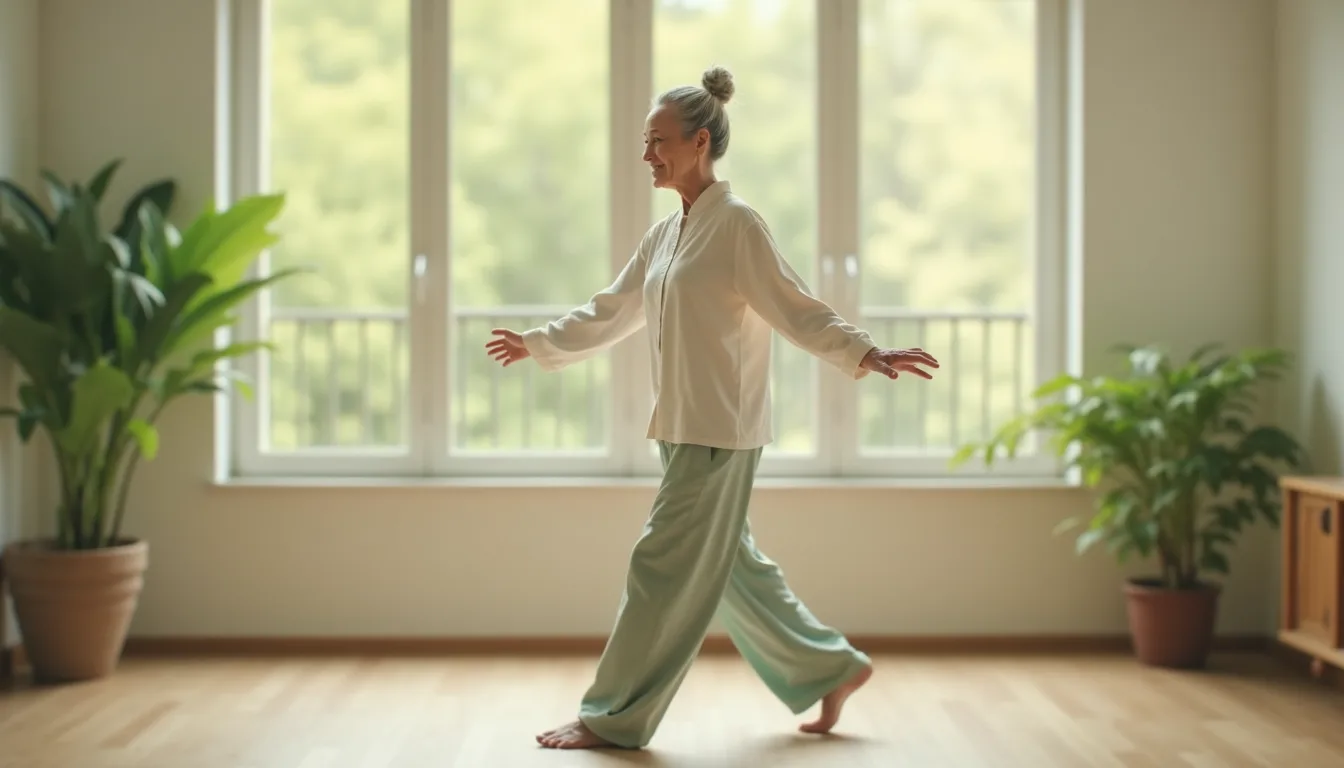
Tai Chi Walking for seniors is a gentle, low-impact form of walking meditation: you step slowly in place (or across a small room) while doing soft Tai Chi arm movements and deep, even breathing. It needs no equipment, takes about 10 minutes a day, and can be done indoors with a sturdy chair or a wall close by for support. For older adults, it is one of the safest ways to stay active because the pace is slow, the movements are small, and you are always in control of your balance.
- What it is: slow, mindful stepping combined with soft Tai Chi arm movements and deep breathing.
- Why seniors love it: low-impact, no equipment, indoor, and easy to do beside a chair or wall.
- How long: about 10 minutes a day is enough to start.
- Safety first: keep one hand near support, move slowly, and never push into pain.
- Free to begin: download our printable routine below and follow along at your own pace.
What Is Tai Chi Walking for Seniors?
Tai Chi Walking is a beginner-friendly bridge between gentle Tai Chi and everyday walking. Instead of marching or pacing for distance, you shift your weight slowly from one foot to the other while your arms flow through calm shapes like Cloud Hands and Gathering Qi. The goal is not speed or step count, but smooth, balanced, breath-led movement. Because each step is deliberate, you build the kind of steady control that helps with daily activities like turning, reaching, and standing up.
Tai Chi in general is recognized as a safe, gentle practice for older adults. The National Center for Complementary and Integrative Health (NCCIH) notes that Tai Chi is generally considered safe and may help with balance and stability in older people (NCCIH: Tai Chi — What You Need To Know). Tai Chi Walking simply slows things down even further, which makes it a comfortable entry point for seniors who are new to movement or returning after a break.
If you want the full beginner overview, our Tai Chi Walking pillar guide walks through the core movements step by step, and our Tai Chi for the 50-plus page collects gentle routines designed for older bodies.
Why It's a Good Fit for Older Adults
For many seniors, the barriers to exercise are joints that ache, worries about falling, and gyms that feel intimidating. Tai Chi Walking removes most of these. There is no impact on the knees or hips, no jumping, and no equipment to buy. You stay in one small, familiar space at home, so you are never far from a chair, counter, or wall.
- Gentle on joints: slow, flowing motion instead of pounding or jarring.
- Balance practice built in: shifting weight one foot at a time trains stability.
- Calming for mind and breath: the deep breathing makes it a true "meditation in motion." You can read more about that in our guide to Tai Chi as meditation in motion.
- Easy to scale: do one minute or ten, seated or standing, depending on the day.
Harvard Health has described Tai Chi as a low-impact, gentle exercise well suited to people of all ages and fitness levels, and the CDC encourages older adults to include balance activities in their week. Tai Chi Walking quietly delivers both gentle movement and balance work in the same short routine.
Safety First: Chair and Wall Support
The single most important rule for seniors is to stay within reach of support. Before you begin, set up a stable space so you can move with confidence.
- Choose your anchor. Stand beside a sturdy, non-rolling chair, a kitchen counter, or a clear stretch of wall.
- Keep one hand free to catch you. Rest your fingertips lightly on the support, or hover your hand just above it, ready to hold on.
- Clear the floor. Remove rugs, cords, and clutter. Wear flat shoes or grippy socks, not slippery ones.
- Go slow. Every step and arm movement should feel unhurried. If you feel dizzy, stop and sit down.
- Breathe, don't hold. Inhale gently through the nose, exhale softly. Never hold your breath.
If standing feels unsafe today, you can do the same arm movements and breathing entirely seated. Our seated Tai Chi guide shows how to keep the practice going from a chair, which is a great option on lower-energy days or while recovering.
A Simple 10-Minute Tai Chi Walking Routine for Seniors
Here is a gentle routine you can follow beside your chair or wall. Move at half the speed you think you need. There is no wrong pace, only your pace.
| Step | What to do | Time |
|---|---|---|
| 1. Settle and breathe | Stand tall beside your support. Soften the knees. Take 5 slow breaths. | 1 min |
| 2. Weight shifts | Shift weight gently from one foot to the other, no stepping yet. | 2 min |
| 3. Slow stepping in place | Lift one foot a little, place it down, then the other. Hand near support. | 2 min |
| 4. Cloud Hands | Float your hands slowly side to side at waist height as you sway. | 2 min |
| 5. Gathering Qi | Raise both hands gently up the front of the body on an inhale, lower on the exhale. | 2 min |
| 6. Cool down | Return to stillness, hands resting low. Take 5 slow breaths. | 1 min |
That is the whole routine. Repeat the steps you enjoy most, skip any that feel awkward, and stop the moment anything hurts. Consistency matters more than intensity, so a calm 10 minutes most days will do far more than an occasional long session.
Download the Free Printable Routine
You don't need to memorize anything. We've put this gentle sequence into a one-page guide you can keep by your chair. Download the free printable Tai Chi Walking routine (PDF), print it in large, easy-to-read text, and tick off each step as you go.
Free printable walking routine (PDF)
Get the 7-day Tai Chi walking routine as a PDF. Print it, put it on the fridge, start today.
🎁 Bonus: a printable 28-day tracking calendar
We can email it to you too — tick off each day and enjoy one gentle reminder a week.
No thanksWant the full printable pack?
28 illustrated movements + 28 full-page cards + 6 planners; $9.90 one-time.
Yes, show me the packYour PDF is opening in a new tab.When you're ready to build a steady habit, our 28-day program gives you a gentle day-by-day path so you never have to wonder what to practice next. The printable challenge PDF is free, and Day 1 is free in the app. It is designed to grow with you, starting small and adding just a little at a time.
Frequently Asked Questions
Is Tai Chi Walking safe for seniors with balance problems?
Yes, when done carefully. Always practice beside a sturdy chair, counter, or wall with one hand near support, move very slowly, and clear the floor of trip hazards. If standing feels unsafe, do the same arm movements and breathing seated. Tai Chi is generally considered safe for older adults, but check with your doctor first if you have a fall history, dizziness, or a recent injury.
How long should a senior do Tai Chi Walking each day?
About 10 minutes a day is a great starting point. You can break it into shorter one- or two-minute sessions if that feels easier. Consistency matters more than length, so a short calm practice most days of the week is better than one long session now and then.
Do I need any equipment or special shoes?
No equipment is required. You only need a small clear space and something sturdy nearby for support, such as a chair or wall. Wear flat, non-slip shoes or grippy socks, and avoid slippery surfaces. That's the beauty of Tai Chi Walking for seniors: it is free, indoor, and ready whenever you are.
Can I do Tai Chi Walking sitting down?
Yes. The arm movements like Cloud Hands and Gathering Qi and the deep breathing all work beautifully from a chair. Seated practice is a smart choice on tired days, while recovering, or any time standing feels unsteady. You still get the gentle movement and calming, focused breathing.
Is this really free?
Yes. The routine on this page is free to follow, and the printable PDF is a free download. Our companion Tai Chi Coach app also offers free guided sessions so you can follow along at your own pace whenever you like.
Next step
Practice along with the free Tai Chi Coach app
Want a calm voice to guide each gentle step? Download the free Tai Chi Coach app and follow along with senior-friendly Tai Chi Walking sessions you can do beside your chair, at your own pace, in just 10 minutes a day.