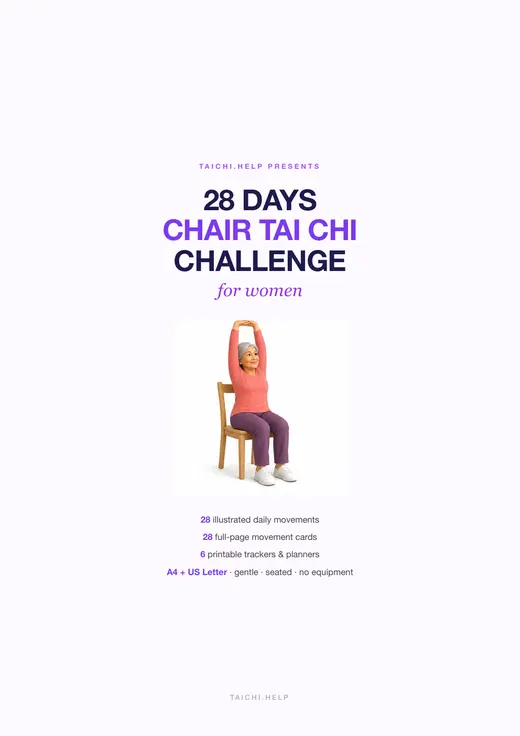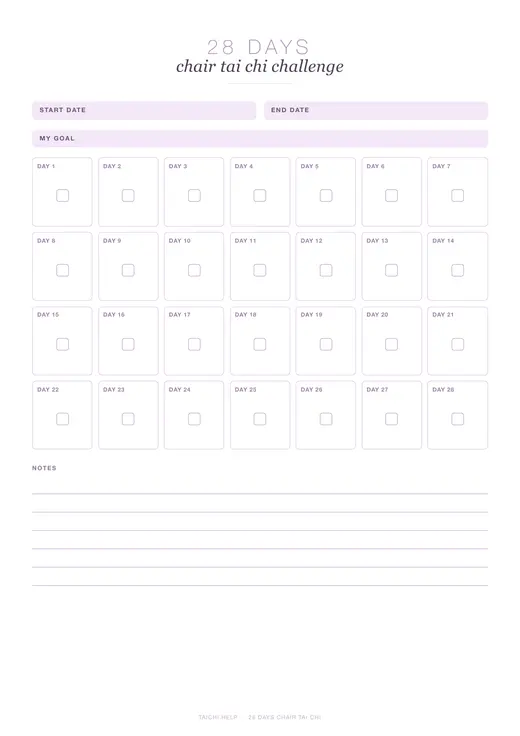
28-Day Chair Tai Chi
$4.90tax included
The complete printable PDF for this programme.
- A4 and US Letter files included
- One-time payment, no subscription
Women and men figures included
Get this programme

Chair Tai Chi for Seniors, Beginners, and Desk Workers
Quick answer: Seated tai chi exercises are gentle chair routines that help seniors, beginners, and desk workers improve balance, posture, circulation, and calm in just a few minutes a day.
Use them for a desk break, a low-impact reset, or a safer way to practice when standing routines feel too demanding.
Choose your version
Main page signal
Use the main seated Tai Chi page for the guided routine. Use the printable PDF page only if you want a one-page sheet.
Follow along from a sturdy chair — no equipment, no floor work, beginner friendly.


Get the one-page seated routine as a PDF. Print it, put it on the fridge, start today.
We can email it to you too — tick off each day and enjoy one gentle reminder a week.
No thanksA perfect solution for specific needs.
Use desk tai chi to reduce tech neck, shoulder tension, and stiffness after long screen hours.
Stay active with gentle chair-based movement that supports balance, circulation, and confidence.
Start with simple seated routines when standing practice feels too hard, tiring, or unstable.
If you want a workday routine, explore Desk Tai Chi for Office Workers. If you want a gentle standing option, try Tai Chi Walking. If you want a simple daily plan, start the 28-Day Program. If you want senior-safe tips, read our seated tai chi for seniors guide.
Absolutely. Tai Chi is primarily about internal movement (Qi) and spinal alignment. Your legs provide a base, but the real work happens in the torso, shoulders, and breath.
Sitting often compresses the lumbar spine. Our seated routines focus on "lifting the crown," which creates space between vertebrae and engages the deep abdominal muscles.
Classic movements like "Cloud Hands" and "Opening the Chest" are performed exactly the same way seated as standing. You keep nearly all of the upper-body and respiratory benefits, since these movements don't depend on your legs.
A 5-minute seated flow is arguably the most efficient "reset button" for a stressed brain. It helps shift you from sympathetic (stress) toward parasympathetic (rest) nervous system dominance, often within a few minutes.
Seated tai chi is a gentle, chair-based version of tai chi you can do in about 10 minutes using these five slow, flowing moves, no standing or balance required.
Sit tall on the front edge of a sturdy, armless chair with your feet flat and shoulder-width apart, knees at about 90 degrees. Keep your spine straight but not rigid and your shoulders relaxed, as if a thread were gently lifting the crown of your head.
Rest your hands on your thighs, then inhale as you float both arms up to shoulder height with the palms facing down. Exhale as you gently press them back down, and repeat for 3 to 5 slow breaths.
Bring both hands in front of your belly as if holding an invisible ball, keeping your shoulders soft. Inhale to widen the hands slightly, then exhale to bring them closer together.
Gently turn your torso to the left, then to the right, while your hands trace slow circles in front of your chest. This loosens the spine, waist, and shoulders.
Raise one arm as you slowly straighten the opposite leg forward and touch the heel to the floor, then return to the start. Repeat on the other side to build gentle coordination.
Move slowly and breathe naturally through all five poses, and download our free printable PDF or open the app for the full guided seated tai chi program.
Ideally, use a stable chair without armrests (or sit at the edge) so your arms can move freely. Your feet should be flat on the floor.
Yes! Many of our movements are subtle and perfect for a "micro-break" that won't draw attention.
Yes. While it won't spike your heart rate like cardio, it improves circulation, flexibility, and muscle tone.
Download the app and discover our dedicated "Office & Seated" category.
Price & Availability

According to major health institutions, regular Tai Chi practice may support balance, stress management, and overall well-being.
Concise answers to common pre-purchase questions and objections.
Cross-Sell
$4.90tax included
The complete printable PDF for this programme.
$9.90tax included
Bought separately: $19.60
A different programme for every day