

Reviewed by Tai Chi Coach Editorial Team
Reviewed for source accuracy, safety framing, and scope clarity on 2026-03-08. This is educational wellness content, not diagnosis or treatment advice. See our Editorial Policy.
Does Online Tai Chi Really Help Knee Osteoarthritis? A 2025 RCT Breakdown
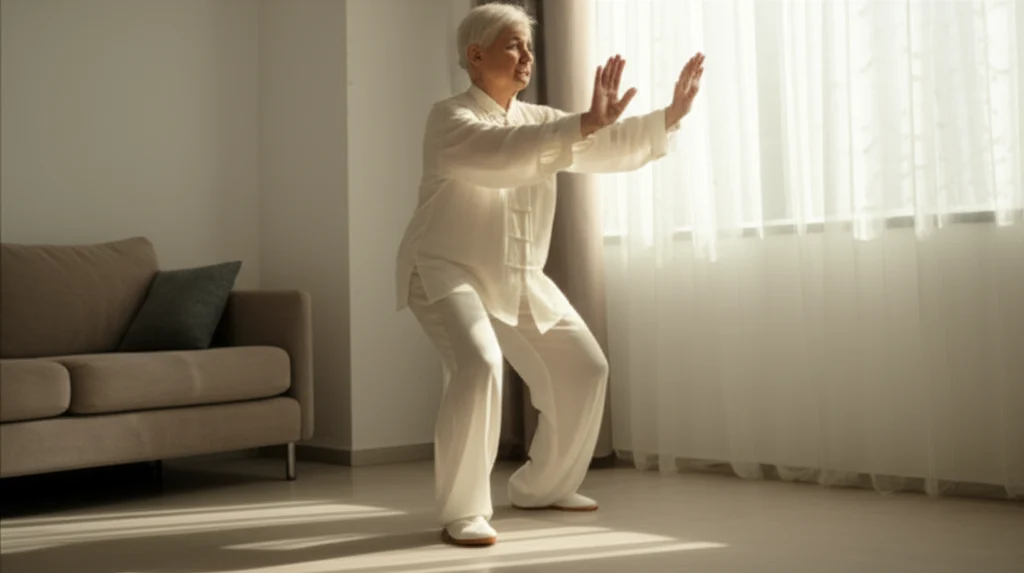
Watch the video summary
Subtitles are available in your page language and English.
Subtitle files: .vtt (English)
Does Online Tai Chi Really Help Knee Osteoarthritis? A 2025 RCT Breakdown
Table of Contents
- Bottom line first
- What the 2025 RCT actually found
- How to apply this in real life
- An 8-week starter plan
- Common mistakes
- FAQ
Bottom line first
Yes, it helps when you follow a structured plan. A 2025 randomized clinical trial found meaningful pain improvement with online Tai Chi for knee osteoarthritis. The trial followed 178 people with knee osteoarthritis for 12 weeks.
Short, consistent sessions beat long, irregular sessions.
What the 2025 RCT actually found
The JAMA Internal Medicine trial (RETREAT, Australia) compared a free, unsupervised online Tai Chi program with an education website about osteoarthritis and exercise.
- Sample size: 178 adults with knee osteoarthritis (about 70% women)
- Mean age: about 62 years
- Duration: 12 weeks of video-based Yang-style Tai Chi at home
- Primary endpoints: knee pain while walking (0-10) and physical function (WOMAC)
| Outcome | Online Tai Chi | Control | Practical meaning |
|---|---|---|---|
| Knee pain change (0-10) | -2.7 | -1.3 | Clear Tai Chi advantage (P<.001) |
| Function change (WOMAC 0-68) | -12.0 | -6.9 | Clear Tai Chi advantage (P<.001) |
| Meaningful pain improvement | 73% | 47% | More people felt a real difference |
| Delivery format | Unsupervised video program at home | Education website | Home-friendly model |
Source: - JAMA Internal Medicine / PubMed 41143827
Attention: this does not mean Tai Chi is a miracle for everyone. It means low-impact home practice can produce clinically relevant change.
How to apply this in real life
A simple order that tends to work:
- Start with pain-aware movement quality.
- Build balance and hip control next.
- Extend session duration last.
Why this order? Adherence is the real win in knee osteoarthritis. If you can stay consistent, pain and stiffness usually improve together.
An 8-week starter plan
Weeks 1-2
- 4 sessions per week
- 10-12 minutes per session
- Focus: breathing rhythm and gentle transitions
Weeks 3-4
- 4 sessions per week
- 15 minutes
- Focus: weight shift and knee alignment
Weeks 5-6
- 5 sessions per week
- 18-20 minutes
- Focus: safe single-leg balance preparation
Weeks 7-8
- 5 sessions per week
- 20-25 minutes
- Focus: smoother flow and movement confidence
Track these metrics:
- First-10-steps morning pain (0-10)
- Stair descent comfort (easy / medium / hard)
- Weekly session count
Common mistakes
- Going hard in week one, then quitting in week two
- Letting the knee collapse inward during transitions
- Holding breath while moving
- Stopping completely on higher-pain days
A good rule: reduce intensity on bad days, but keep the habit alive.
Quick decision table
| Situation | What to do | What to avoid |
|---|---|---|
| Pain 0-3/10 | Continue normal flow | Rushing movement quality |
| Pain 4-6/10 | Cut duration by 30% | Deep painful knee flexion |
| Pain 7+/10 | Seated Tai Chi + breath work | Pushing through sharp pain |
FAQ
Can I practice Tai Chi every day with knee osteoarthritis?
Yes, if you scale intensity to symptoms and keep sessions short.
When do people usually feel improvement?
Many feel less morning stiffness in 2-4 weeks. Clearer change usually needs 8-12 weeks.
Is online Tai Chi safe?
It can be very safe when you start at the right level and progress gradually.
The 2025 RCT gave a practical message: online Tai Chi is a strong option for knee osteoarthritis pain management when consistency is in place.
Next step
Try a knee-friendly Tai Chi start
Open Tai Chi Coach for gentle guided sessions that support knee comfort, smoother movement, and steadier balance at home.