

Reviewed by Tai Chi Coach Editorial Team
Reviewed for source accuracy, safety framing, and scope clarity on 2026-11-20. This is educational wellness content, not diagnosis or treatment advice. See our Editorial Policy.
Balance Exercises for Seniors: A Free Printable Routine with Pictures
Free printable balance routine
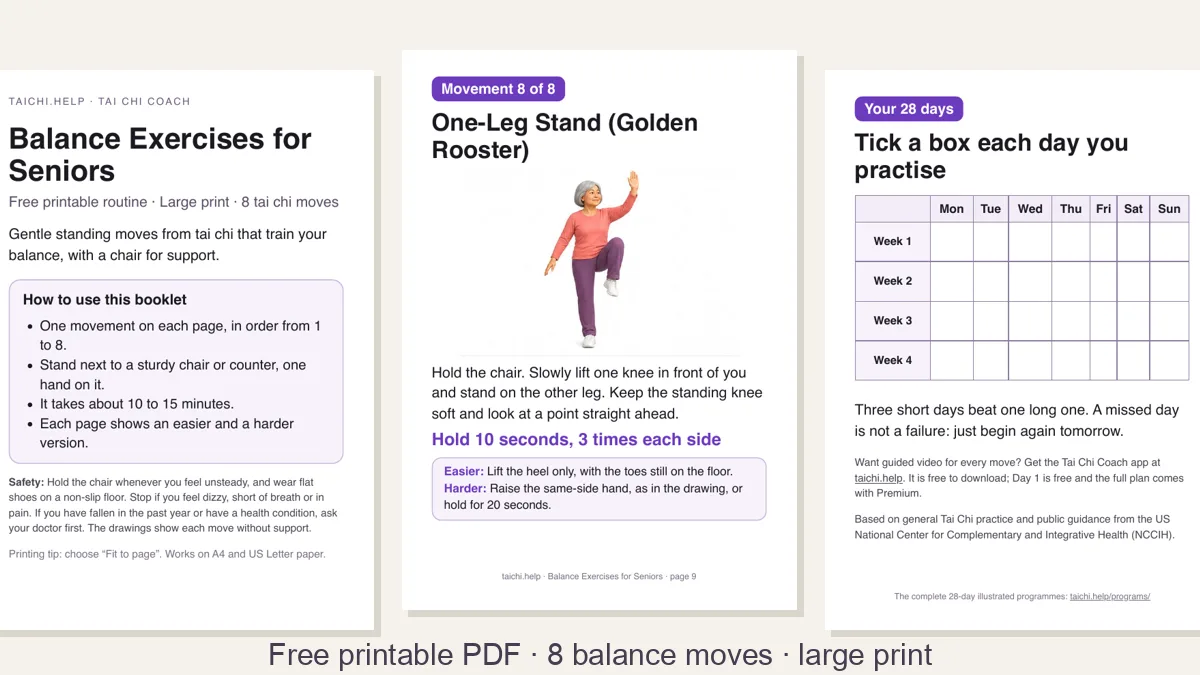
Get the 11-page large-print PDF: 8 balance moves with pictures, a 28-day tracker and safety tips. Print it and keep it next to your chair.
Want the full printable pack?
The Active Set: three illustrated 28-day programmes (standing tai chi, walking and qigong); $9.90 one-time.
Yes, show me the packYour PDF is opening in a new tab.- What it is: a free, large-print PDF with 8 gentle standing balance moves from tai chi, one move per page, each with a picture.
- Who it is for: older adults who want to feel steadier at home, and caregivers or activity leaders who print routines for others.
- How long: about 10 to 15 minutes.
- Equipment: a sturdy chair or kitchen counter to hold, flat shoes and a clear, non-slip floor.
- Safety first: hold on whenever you need to. Every move has an easier and a harder version.
What's inside the free printable PDF
The PDF has 11 pages in large print. The first page explains how to use it and how to stay safe. Each of the next 8 pages shows one move with a big drawing, three short steps, how many times to do it, and an easier and a harder version. Then comes a 28-day tracker where you tick a box each day you practise, and a last page about our full printable programmes.
It prints on A4 or US Letter paper. Choose "Fit to page" in the print window. Many people keep the pages next to the chair they practise with, or on the fridge.
Before you start: set up a safe spot
- Use a sturdy chair without wheels, placed against a wall, or stand at a kitchen counter.
- Wear flat shoes with a good grip, or go barefoot on a non-slip floor. Move rugs and clutter out of the way.
- The first few times, it can help to have someone nearby.
- Stop if you feel dizzy, short of breath or in pain.
- If you have fallen in the past year, often feel dizzy, or have a health condition, ask your doctor or physiotherapist before you start.
The 8 balance exercises, step by step
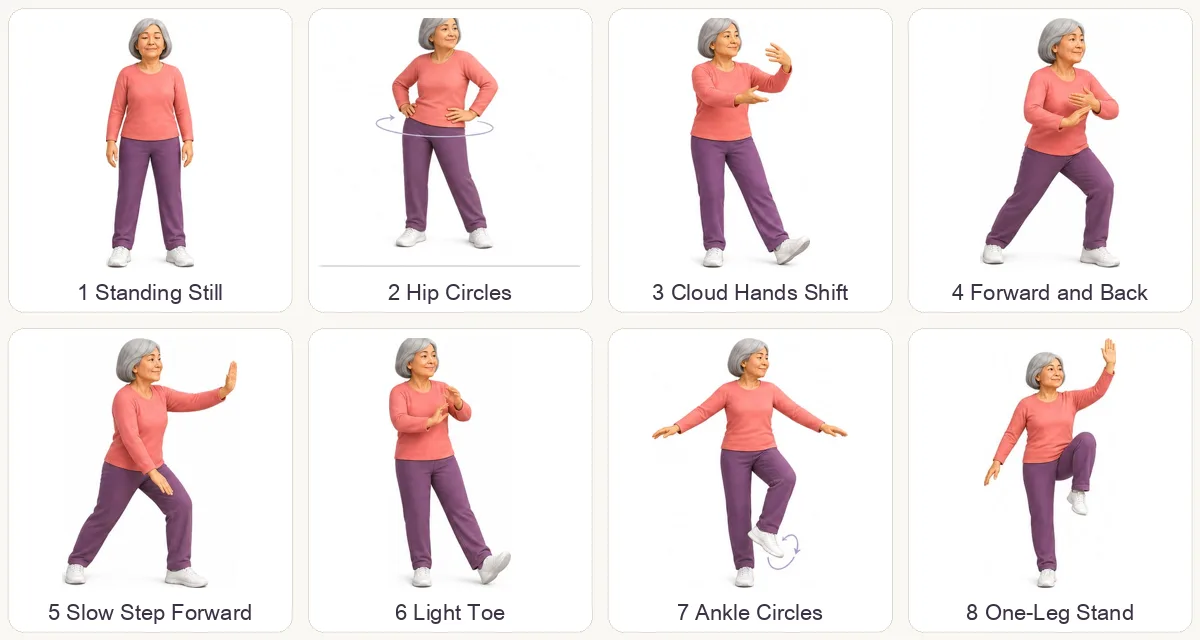
Do the moves in order. Stand next to your chair or counter and rest a hand on it. Move slowly and keep breathing. The same steps are in the PDF, one move per page.
1. Standing Still (Wu Chi)
Stand with your feet hip-width apart and your knees soft. Let your weight settle evenly over both feet. Breathe slowly and feel the floor under your heels and toes. Hold for 5 slow breaths.
- Easier: Hold the chair with both hands.
- Harder: Let go of the chair and rest your hands by your sides.
2. Hip Circles
Rest one hand on the chair and the other on your hip. Move your hips slowly in a small circle, so your weight travels around your feet. Keep both feet flat. 5 circles each way.
- Easier: Make the circle smaller.
- Harder: Rest both hands on your hips.
3. Cloud Hands Weight Shift
Stand with your feet a little wider than your hips. Shift your weight slowly onto the right foot, then onto the left. Let your free hand float past your face as you turn. 8 times each side.
- Easier: Keep one hand on the chair and move only the other arm.
- Harder: Move both arms and pause for 2 seconds on each side.
4. Forward and Back
Step one foot forward a comfortable distance. Slowly rock your weight onto the front foot, then back onto the back foot. Keep your back upright. 8 times, then switch feet.
- Easier: Take a smaller step and keep holding the chair.
- Harder: Pause for 3 seconds at the front and at the back.
5. Slow Step Forward
Shift your weight onto one foot. Step the other foot forward, heel first, then roll your weight onto it. Bring the back foot next to the front foot. That is one step. 4 steps with each foot.
- Easier: Walk along a kitchen counter so a hand can rest on it.
- Harder: Step more slowly, as if the floor were thin ice.
6. Light Toe
Put almost all your weight on your back leg. Touch the front toe lightly to the floor, as if testing bath water. Stay tall and keep breathing. Hold 10 seconds, 3 times each side.
- Easier: Hold the chair with both hands.
- Harder: Lift the front toe just off the floor.
7. Ankle Circles on One Foot
Hold the chair. Lift one foot a little off the floor and circle the ankle slowly. Your standing leg does the balance work. 5 circles each way, each foot.
- Easier: Keep the toes of the moving foot on the floor.
- Harder: Hold the chair with one fingertip only.
8. One-Leg Stand (Golden Rooster)
Hold the chair. Slowly lift one knee in front of you and stand on the other leg. Keep the standing knee soft and look at a point straight ahead. Hold 10 seconds, 3 times each side.
- Easier: Lift the heel only, with the toes still on the floor.
- Harder: Raise the same-side hand, or hold for 20 seconds.
How to progress over 4 weeks
Balance improves when the exercise is a little challenging but still safe. Use less support only when your current level has felt easy for a few days.
- Week 1: both hands on the chair, shorter holds.
- Week 2: one hand on the chair.
- Week 3: fingertips on the chair.
- Week 4: hands hovering just above the chair, only if you feel steady. Hold on again at any time.
Tick a box on the 28-day tracker after each session. Three short days a week beat one long session.
A seated version if standing isn't safe yet
If standing practice feels risky today, start sitting down. Our free chair exercises for seniors PDF and the seated tai chi routine can be done entirely from a chair. Come back to the standing moves when you feel ready.
Why tai chi for balance?
Tai chi is slow weight-shifting on purpose: you move your weight from one foot to the other, step with control and stand on one leg for a moment. These are the same skills you use to stay steady when you walk, turn or reach. Public health agencies such as the CDC include tai chi-based programmes among exercise options for preventing falls in older adults, and the US National Center for Complementary and Integrative Health notes that tai chi may help improve balance in older people. For the research in more detail, read tai chi for balance: what the science says, or see our balance and fall prevention guide.
Frequently Asked Questions
Is the balance exercises for seniors PDF really free?
Yes. Enter your email in the box on this page and the 11-page PDF opens instantly. There is no payment, and you can unsubscribe from our emails anytime.
What can elderly people do to improve balance at home?
Short, regular practice of weight shifts, slow steps and supported one-leg stands, holding a sturdy chair or kitchen counter. Many older adults find slow programmes like tai chi easy to keep up. Start with support and use less of it only when a level feels easy.
What are good 10-minute balance exercises for seniors?
The 8 moves in this PDF take about 10 to 15 minutes: standing still, hip circles, cloud hands weight shift, forward and back, slow step forward, light toe, ankle circles on one foot and a supported one-leg stand.
Are there free printable chair exercises for seniors?
Yes. If standing is hard for you right now, use our free chair exercises for seniors PDF, which you can do entirely sitting down.
How often should I do balance exercises?
Most people can do this routine on most days of the week. Short, regular sessions are easier to keep up than long, occasional ones. If you have a health condition, ask your doctor how much is right for you.
Can tai chi help with balance?
Tai chi trains slow weight shifting, controlled stepping and standing on one leg, the skills you use to stay steady. Health agencies such as the CDC and NCCIH describe tai chi as a way for older adults to improve balance. It does not replace medical advice if you fall often or feel dizzy.
Want a full 28-day plan?
The free routine is a good start. For a day-by-day plan, start with the 28-Day Tai Chi Plan for Beginners ($4.90), or get the Active Set: three illustrated 28-day programmes (standing tai chi, walking and qigong) for $9.90 one-time.
See the Active SetNext step
Take it further with the Tai Chi Coach app
Prefer to follow along with video? The Tai Chi Coach app has guided seated and standing routines for seniors and beginners. It is free to download; Day 1 is free and the full plan comes with Premium.