

Reviewed by Tai Chi Coach Editorial Team
Reviewed for source accuracy, safety framing, and scope clarity on 2026-06-25. This is educational wellness content, not diagnosis or treatment advice. See our Editorial Policy.
Tai Chi Indoor Walking: A Step-by-Step Routine for Small Spaces
Page guide
Looking for Tai Chi walking?
Use the main Tai Chi walking page for the guided 28-day path. Use the PDF page only if you want a printable sheet.
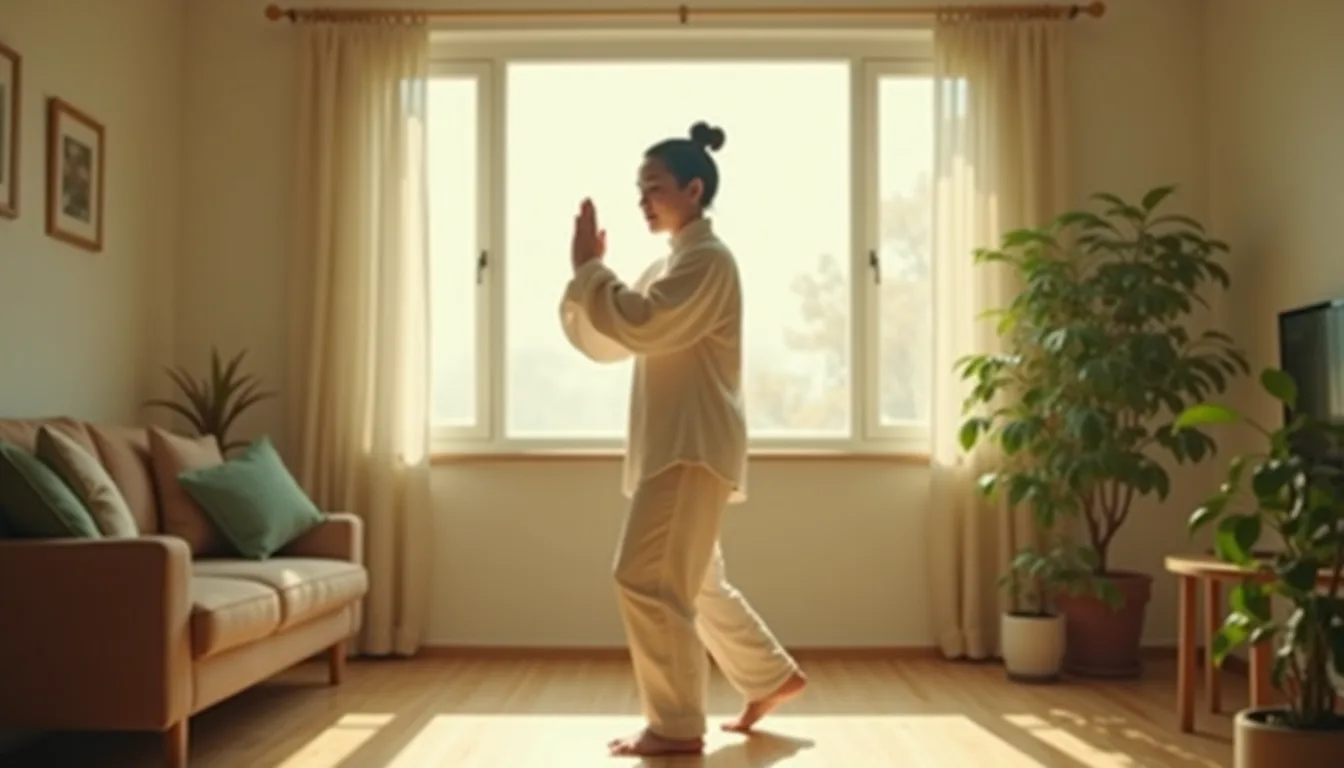
Tai chi indoor walking is a gentle, low-impact way to walk slowly in place while doing soft tai chi arm movements and deep breathing — all in a space no bigger than a bath mat. You don't cover any distance, so an apartment living room, an office cubicle, or the floor beside your bed is plenty of room. A complete session takes about 10 minutes, needs no equipment, and is easy on the knees, hips, and back.
Below you'll find a step-by-step in-place routine plus tips for tiny rooms, balance, and breathing. It's a supporting how-to for our main pillar, Tai Chi Walking: A Gentle Indoor Routine, where you'll also find a free printable 7-day plan.
Key Takeaways
- What it is: Tai chi indoor walking is walking meditation done in place — slow steps synced to your breath with flowing arm movements.
- Space needed: About one arm-span (a 3 ft by 3 ft / 1 m square) is enough; no equipment required.
- How long: Roughly 10 minutes a day, broken into warm-up, stepping, and cool-down.
- Who it's for: Beginners, seniors, desk workers, and anyone wanting joint-friendly, calming movement at home.
- Safety: Keep a wall or sturdy chair within reach and slow down if you feel unsteady or short of breath.
What Is Tai Chi Indoor Walking?
Tai chi indoor walking is a low-impact form of walking meditation done without traveling across a room. Instead of taking long strides, you lift and place your feet slowly and deliberately — often marching gently in place — while your arms move in soft tai chi patterns and your breath stays slow and even. The goal isn't distance or speed; it's smooth, mindful movement that builds balance, leg strength, and calm.
According to the National Center for Complementary and Integrative Health (NCCIH), tai chi is a gentle practice that may help with balance and well-being, and most styles can be adapted to your ability. Doing it indoors, in place, removes the barriers of weather, distance, and crowded sidewalks. It pairs naturally with seated tai chi when you want an even lower-impact day.
How Much Space Do You Really Need?
Less than you'd think. Because you step in place, the limiting factor is your arm reach, not your stride. If you can stand with feet hip-width apart and raise both arms to shoulder height without hitting anything, you have enough room.
| Location | Space to clear | What to adjust |
|---|---|---|
| Apartment living room | One arm-span square (~3 ft / 1 m) | Move a coffee table; face an open wall. |
| Office or cubicle | Just your standing footprint | Keep arm movements small and slow; step softly in place. |
| Beside the bed | The strip of floor by the mattress | Use the bed frame or wall as a light balance touchpoint. |
| Hotel room or dorm | The foot of the bed | Shorten arm sweeps; keep steps low and quiet. |
Clear small trip hazards (rugs with curled edges, cords, pet toys) before you start, and wear flat shoes or grippy socks rather than slippery ones.
Step-by-Step In-Place Routine (About 10 Minutes)
Follow these phases in order. Move at roughly half the speed of normal walking — slow enough that you could stop on one foot at any moment without wobbling.
- Center and breathe (1 minute). Stand with feet hip-width apart, knees soft, arms relaxed. Inhale slowly through the nose for a count of four, exhale for four. Let your shoulders drop. This settles your balance before you move.
- Gathering Qi warm-up (2 minutes). On an inhale, float both arms up to chest height as if lifting a beach ball. On the exhale, lower them slowly. Keep elbows soft and let the breath lead the arms. Repeat gently.
- Stepping in place (4 minutes). Shift your weight onto your left foot, then slowly lift your right knee a few inches and set the foot back down. Shift right and lift the left. Keep it smooth and quiet — you're "walking" without going anywhere. Sync each step to a relaxed out-breath.
- Cloud Hands with steps (2 minutes). As you keep stepping in place, sweep one hand across your body at waist height while the other drifts up to shoulder height, then switch. Let your waist turn gently so the arms float rather than push.
- Cool down (1 minute). Return to a still stance, lower the arms, and take three more slow breaths. You'll feel warmer and calmer without ever leaving your spot.
If a movement feels awkward, make it smaller — precision and slowness matter far more than range of motion. To build the habit, our 28-day program spreads gentle sessions like this across four weeks.
Tips for Tight Spaces and Better Balance
- Use a wall as a guide. Standing about a foot from a wall gives you a quick touchpoint if you sway — helpful by the bed or in a hallway.
- Shrink the arms before the steps. In an office or cubicle, keep arm sweeps within shoulder width and step almost silently; the breathing and weight shifts still do the work.
- Keep eyes soft and level. Looking gently ahead, not down at your feet, steadies your balance more than staring at the floor.
- Mind the weight shift, not the height. You don't need to lift your knees high. Clearly shifting weight from one foot to the other is what builds steadiness.
- Stop when winded. The CDC emphasizes fall prevention for older adults, so keep support nearby and rest the moment you feel unsteady or out of breath.
Want the same gentle approach aimed at older adults? See our companion piece free tai chi walking for seniors, and the broader tai chi for the 50-plus hub.
Indoor vs. Outdoor Walking: What's Different?
Both are gentle, but they solve different problems. Outdoor walking gives you fresh air and distance; tai chi indoor walking gives you control, privacy, and zero weather excuses.
| Tai chi indoor walking | Regular outdoor walking | |
|---|---|---|
| Space | One arm-span; in place | Sidewalks, paths, distance |
| Impact | Very low; slow weight shifts | Low to moderate |
| Focus | Breath, balance, mindful arms | Pace, steps, scenery |
| Weather | Never a factor | Rain, heat, ice can stop you |
| Best for | Small homes, calm, consistency | Cardio volume, daylight, nature |
Many people do both: a slow indoor session on busy or bad-weather days, and a longer outdoor walk when time and weather allow. Because it doubles as a mindfulness practice, indoor tai chi walking also pairs well with the calm-focus benefits we cover in tai chi as meditation in motion.
Frequently Asked Questions
How much space do I need for tai chi indoor walking?
Very little. Because you step in place rather than travel, you only need about one arm-span — roughly a 3 ft by 3 ft (1 m) square — so you can raise your arms to shoulder height without hitting anything. An apartment living room, an office footprint, or the floor beside your bed all work.
Can I do tai chi indoor walking in a small apartment or office?
Yes. In tight spaces, keep your arm movements small and slow and step almost silently in place. The breathing and weight shifts do most of the work, so a cubicle or the strip of floor by your bed is enough room for a full session.
How long should an indoor tai chi walking session be?
About 10 minutes is a good daily target: roughly 1 minute to center and breathe, 2 minutes of arm warm-up, 4 minutes of stepping in place, 2 minutes of Cloud Hands with steps, and a 1-minute cool-down. You can shorten or repeat the stepping phase as you build comfort.
Is tai chi indoor walking good for beginners and seniors?
It's well suited to both. The movements are slow, low-impact, and easy on the joints, and you can keep a wall or sturdy chair within reach for balance. Health institutions like NCCIH note that tai chi can be adapted to many ability levels, but check with your doctor first if you have balance concerns or a medical condition.
Do I need any equipment or special shoes?
No equipment is required. Wear flat, supportive shoes or grippy socks rather than slippery ones, clear small trip hazards like loose rugs and cords, and keep a wall or chair nearby. That's all you need to start.
Free printable walking routine (PDF)
Get the 7-day Tai Chi walking routine as a PDF. Print it, put it on the fridge, start today.
🎁 Bonus: a printable 28-day tracking calendar
We can email it to you too — tick off each day and enjoy one gentle reminder a week.
No thanksWant the full printable pack?
28 illustrated movements + 28 full-page cards + 6 planners; $9.90 one-time.
Yes, show me the packYour PDF is opening in a new tab.Next step
Practice Tai Chi Indoor Walking with Guided Sessions
Want a gentle voice to pace your steps and breath? The free Tai Chi Coach app guides you through indoor tai chi walking and other low-impact routines you can do in a small space — no equipment, about 10 minutes a day. Download it free on iOS and follow along beside your bed, in the living room, or on a work break.