

Chair Exercises for Weight Loss: A Free Printable Seated Workout for Seniors
Free printable seated workout
Get the 11-page large-print PDF: 8 seated moves with pictures, a 28-day tracker and a 4-week plan. Print it and keep it next to your chair.
Want the full printable pack?
The Seated Set: four illustrated 28-day programmes (seated exercises, chair tai chi, chair yoga and qigong); $9.90 one-time.
Yes, show me the packYour PDF is opening in a new tab.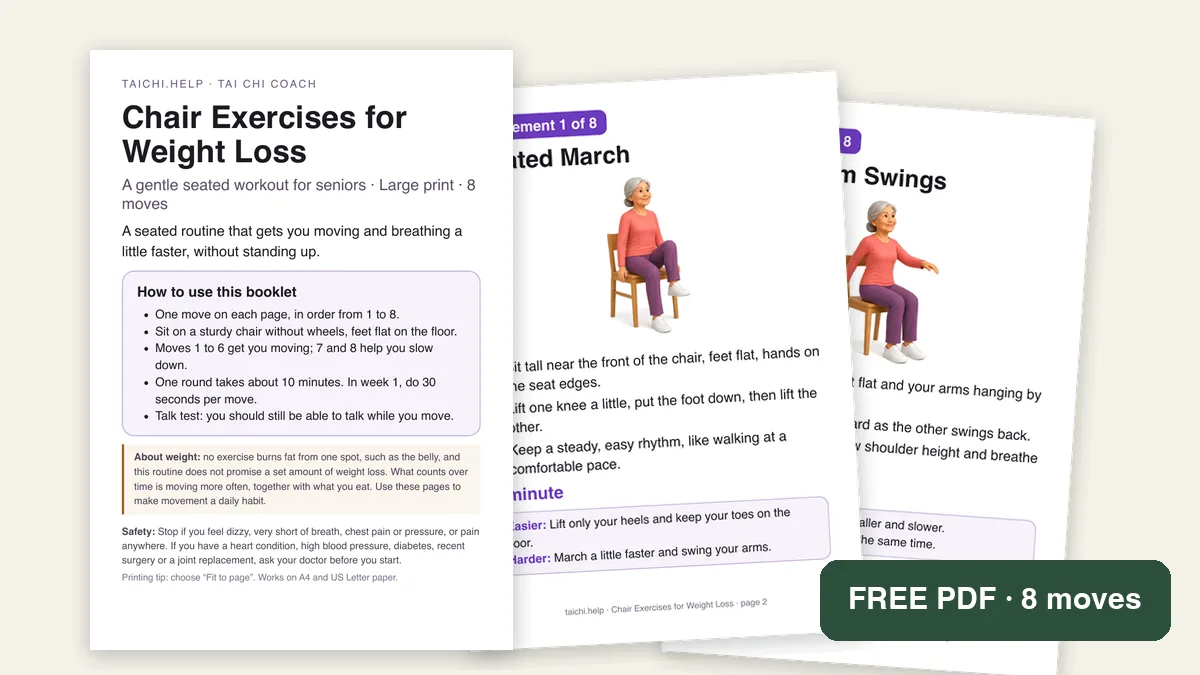
Reviewed by Tai Chi Coach Editorial Team
Reviewed for source accuracy, safety framing, and scope clarity on 2026-11-25. This is educational wellness content, not diagnosis or treatment advice. See our Editorial Policy.
Chair exercises for weight loss help seniors move more every day, but they are a starting point, not a weight-loss fix on their own.
The routine below is a short seated workout that keeps your legs and arms moving steadily and gets you breathing a little faster, for anyone who cannot stand or walk for long. The free printable PDF has 8 seated moves (about 10 minutes a round), a picture of each, and a 28-day tracker. Pair it with everyday eating habits; no chair workout melts fat on its own.
- What it is: a free, large-print PDF with 8 seated moves that you do at a steady rhythm, one move per page, each with a picture.
- Who it is for: older adults who sit a lot and want to move more, and caregivers or activity leaders who print routines for others.
- How long: about 10 minutes a round (about 5 minutes in week 1).
- Equipment: a sturdy chair without wheels. A small water bottle is optional.
- Honest note: this is a way to start moving, not a weight-loss promise.
Before you start: safety and when to stop
Stop right away if you feel chest pain or pressure, dizziness, very short of breath, or pain anywhere. Sit still and rest. If chest pain or sudden breathlessness does not pass, get medical help.
Ask your doctor first if you have a heart condition, high blood pressure, diabetes (some medicines can lower blood sugar during exercise), recent surgery or a joint replacement, or if you often feel dizzy.
- Use a solid, stable chair without wheels, placed against a wall. The NHS also suggests a chair without arms for its sitting exercises.
- Sit near the front of the seat with both feet flat. If your feet don't reach, rest them on a firm book.
- Wear comfortable clothes and keep water nearby.
- Use the talk test: you should still be able to talk while you move. If you can't, slow down.
What's inside the free printable PDF
The PDF has 11 pages in large print. The first page explains how to use it and how to stay safe. Each of the next 8 pages shows one move with a big drawing, three short steps, how long to do it, and an easier and a harder version. Then comes a 28-day tracker with the 4-week plan, and a last page about our full printable programmes.
It prints on A4 or US Letter paper. Choose "Fit to page" in the print window.
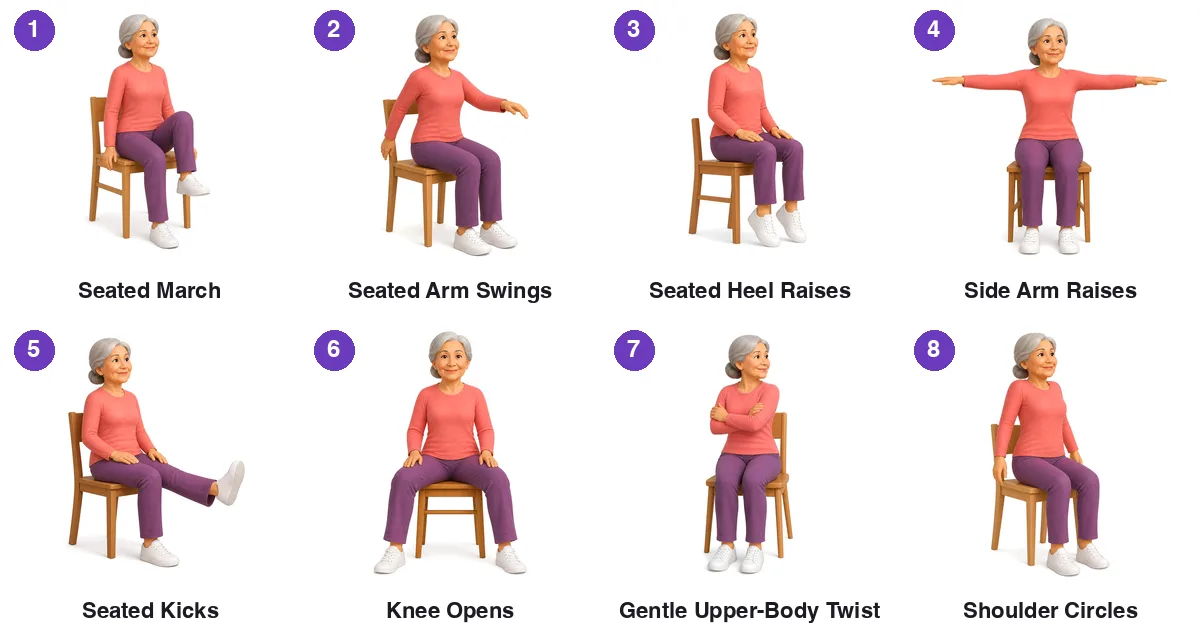
The 8 seated moves, step by step
Do the moves in order. Moves 1 to 6 keep you moving at a steady rhythm; moves 7 and 8 help you slow down. Rest for a few breaths between moves whenever you need to. The same steps are in the PDF, one move per page.
1. Seated March
- Sit tall near the front of the chair, feet flat, hands on the seat edges.
- Lift one knee a little, put the foot down, then lift the other.
- Keep a steady, easy rhythm, like walking at a comfortable pace.
Time: 1 minute.
- Easier: Lift only your heels and keep your toes on the floor.
- Harder: March a little faster and swing your arms.
2. Seated Arm Swings
- Sit tall with your feet flat and your arms hanging by your sides.
- Swing one arm forward as the other swings back.
- Keep the swing below shoulder height and breathe normally.
Time: 1 minute.
- Easier: Make the swing smaller and slower.
- Harder: March your feet at the same time.
3. Seated Heel Raises
- Sit tall with your feet flat, hip-width apart, under your knees.
- Lift both heels and keep your toes on the floor.
- Lower your heels and repeat at a steady pace.
Time: 1 minute.
- Easier: Lift one heel at a time.
- Harder: Go a little faster: heels up, then toes up.
4. Side Arm Raises
- Sit tall with your arms by your sides, palms facing in.
- Raise both arms out to the sides, no higher than your shoulders.
- Lower them slowly. Keep your shoulders away from your ears.
Time: 1 minute.
- Easier: Raise one arm at a time, or stop at half height.
- Harder: Hold a small water bottle in each hand.
5. Seated Kicks
- Sit back so your thighs rest on the chair, feet flat.
- Straighten one knee to lift the foot, toes pointing up.
- Lower it, then kick with the other leg. Smooth, not snappy.
Time: 1 minute.
- Easier: Lift the foot only a little way.
- Harder: Pause for 2 seconds with the leg straight.
6. Knee Opens
- Sit tall with your feet together and your knees pointing forward.
- Step both feet out to the sides as your knees open.
- Step them back in. Keep a steady rhythm.
Time: 1 minute.
- Easier: Open one leg at a time.
- Harder: Raise your arms out to the sides as your knees open.
7. Gentle Upper-Body Twist
- Sit tall, feet flat, arms crossed loosely over your chest.
- Turn your upper body slowly to one side, only half as far as you can.
- Come back to the middle, then turn to the other side.
Time: 5 turns each side.
- Easier: Rest your hands on your thighs and turn less.
- Harder: Hold each turn for one slow breath.
8. Shoulder Circles
- Sit tall with your arms relaxed by your sides.
- Roll both shoulders up, back and down in a slow circle.
- After 5 circles, change direction. Let your breathing settle.
Time: 5 circles each way.
- Easier: Roll one shoulder at a time.
- Harder: Make the circles slower and a little larger, without pain.
How to progress over 4 weeks
Build up the time, not the strain. Move on to the next week only when the current one feels comfortable, and stay longer at a level if you need to.
- Week 1: 30 seconds per move · about 5 minutes.
- Week 2: 45 seconds per move · about 7 minutes.
- Week 3: 1 minute per move · about 10 minutes.
- Week 4: 1 minute per move, a little brisker in moves 1–6.
Tick a box on the 28-day tracker after each session. Short sessions on most days are easier to keep up than one long session a week.
Chair exercise and weight: what to expect
The CDC puts it plainly: most weight loss comes from eating fewer calories, and getting to and staying at a healthy weight takes both regular physical activity and healthy eating. So think of this routine as the movement half of the habit. For older adults, the CDC's activity guidelines also recommend at least 150 minutes a week of moderate activity, muscle strengthening on 2 days and activities that improve balance; a seated routine is a gentle first step toward that.
When sitting feels easy, add more movement. If you can stand safely, try our free balance exercises for seniors PDF. If you can walk, tai chi walking is another gentle way to move more. If you want a calmer seated practice, see chair tai chi or our general chair exercises for seniors PDF.
Frequently Asked Questions
Can you lose weight doing chair exercises?
Chair exercises can be part of it, but they work best as a start, not as the whole plan. The CDC says that most weight loss comes from eating fewer calories, and that regular physical activity is what helps you keep weight off. For someone who sits most of the day, a daily seated routine is an easy way to move more, and you can add walking or standing exercise when you are ready.
Can chair exercises reduce belly fat?
No exercise burns fat from one spot. Seated twists or leg lifts work the muscles around your middle, but your body decides where it loses fat from. Regular movement and your eating habits, over weeks and months, are what change your waistline.
How long should seniors do chair exercises each day?
This routine takes about 10 minutes a round. Start with 30 seconds per move in week 1 and build up. For older adults the CDC recommends at least 150 minutes a week of moderate activity, plus muscle strengthening on 2 days and balance activities. Several short sessions a day count too.
What is the best chair exercise for weight loss?
There isn't a single best one. The moves that keep you moving steadily for a minute or more, such as the seated march, seated kicks and knee opens, raise your breathing the most. The best routine is the one you will actually do most days.
Is the chair exercises for weight loss PDF really free?
Yes. Enter your email in the box on this page and the 11-page PDF opens instantly. There is no payment, and you can unsubscribe from our emails anytime.
Who should check with a doctor first?
Ask your doctor before you start if you have a heart condition, high blood pressure, diabetes, recent surgery or a joint replacement, or if you often feel dizzy. Stop at once if you feel chest pain or pressure, dizziness or pain anywhere.
Want a full 28-day plan?
The free routine is a good start. For a day-by-day plan you do from a chair, start with the 28-Day Seated Exercises for Seniors programme ($4.90), or get the Seated Set: four illustrated 28-day programmes (seated exercises, chair tai chi, chair yoga and qigong) for $9.90 one-time. The Complete Library has all six programmes for $14.90.
See the Seated SetNext step
Take it further with the Tai Chi Coach app
Prefer to follow along with video? The Tai Chi Coach app has guided seated and standing routines for seniors and beginners. It is free to download; Day 1 is free and the full plan comes with Premium.