

Reviewed by Tai Chi Coach Editorial Team
Reviewed for source accuracy, safety framing, and scope clarity on 2026-11-25. This is educational wellness content, not diagnosis or treatment advice. See our Editorial Policy.
Chair Tai Chi for Men Over 60: A Free Printable Seated Routine
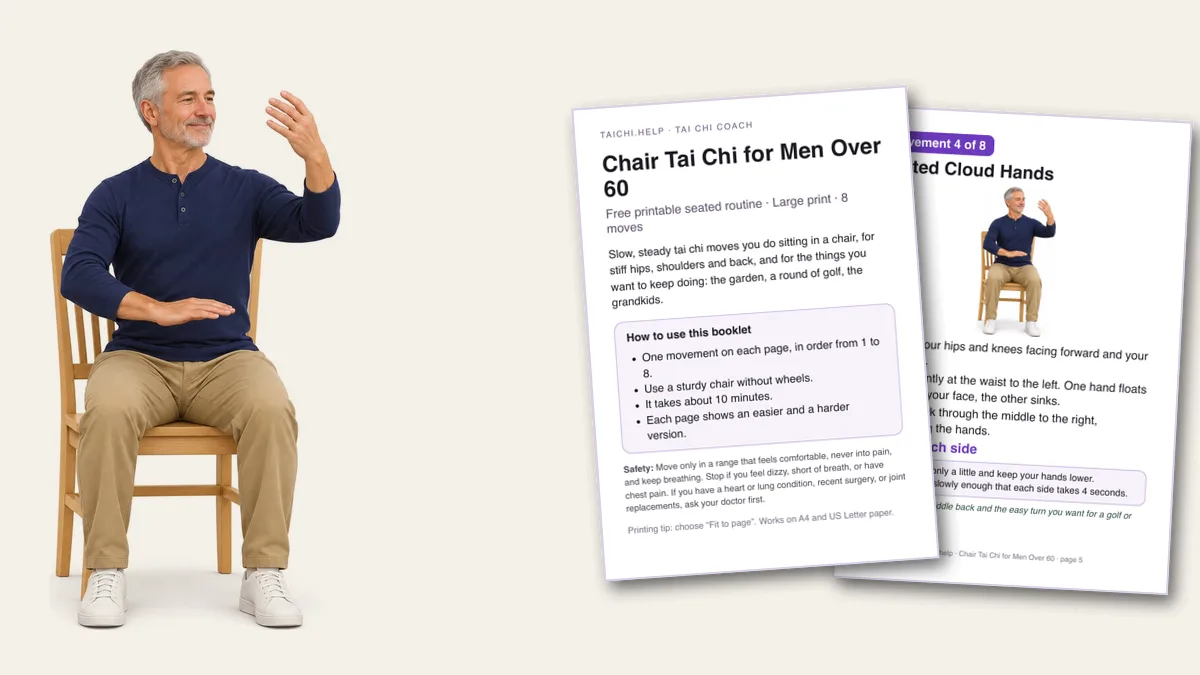
Quick answer: chair tai chi for men over 60 is a set of slow tai chi moves done sitting in a sturdy chair. The free PDF below has 8 of them, about 10 minutes in total, aimed at stiff hips, shoulders and lower back, posture after long hours of sitting, and the everyday things you want to keep doing, from the garden and the golf course to the grandkids.
Watch: 15-Minute Seated Tai Chi (Follow Along)
Prefer to follow along? This full routine is done sitting down, with no standing. The free printable PDF is just below.
Free printable PDF: chair tai chi for men over 60
Get the 11-page large-print PDF: 8 seated moves with pictures, easier and harder versions, and a 28-day tracker.
Want the full printable pack?
The Seated Set: four illustrated 28-day programmes (chair tai chi, chair yoga, qigong and seated exercises); $9.90 one-time.
Yes, show me the packYour PDF is opening in a new tab.- What it is: a free, large-print PDF with 8 seated tai chi moves, one per page, each with a drawing, three short steps and an easier and a harder version.
- Who it is for: men over 60 who want to loosen up and sit and move better, including beginners and anyone not ready to practise standing.
- How long: about 10 minutes.
- Equipment: a sturdy chair without wheels and a flat floor.
What's inside the free printable PDF
The PDF has 11 pages in large print. Page 1 explains how to use it and when to stop. Each of the next 8 pages shows one move with a drawing, three numbered steps, how many times to do it, an easier and a harder version, and the everyday job it helps with. Then comes a 28-day tracker to tick off each session, and a last page about our full printable programmes.
It prints on A4 or US Letter paper; choose "Fit to page" in the print window.
Why start in a chair?
Starting seated is not about taking it easy. It takes balance out of the picture, so all your attention goes to slow, controlled movement, breathing and posture. That makes it a sensible first step if your hips, back or knees are stiff, if you have not exercised in a while, or if you simply want something you can do in the living room before the day gets busy.
The NCCIH says tai chi appears to be safe and may be beneficial in improving balance and preventing falls in older adults. It also says not to use tai chi to put off seeing a health care provider about a medical problem. The CDC guidelines for adults 65 and older recommend aerobic activity, muscle-strengthening activity on at least 2 days a week, and activities that improve balance, and remind you that some physical activity is better than none. A short seated routine will not cover all of that on its own, but it is an easy habit to build on.
Wondering whether it is "enough" of a workout? The harder version on each page asks for slower moves and longer holds. When the seated routine feels easy, you can move on to standing practice (see below).
Before you start
- Use a sturdy chair without wheels, ideally against a wall. Sit near the front of the seat with your feet flat.
- Move slowly and only in a range that feels comfortable, never into pain. Keep breathing.
- Stop if you feel dizzy, short of breath, or have chest pain.
- If you have a heart or lung condition, have had recent surgery or a joint replacement, ask your doctor before you start.
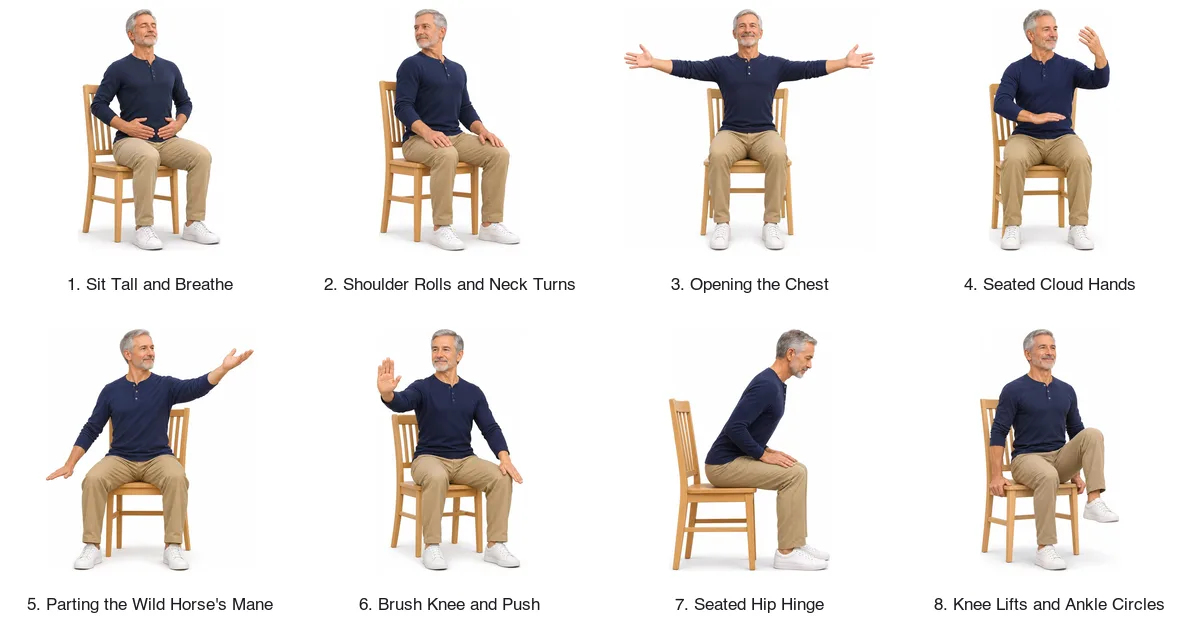
The 8 chair tai chi moves, step by step
Do the moves in order. They are the same as in the PDF, one move per page.
1. Sit Tall and Breathe
- Sit near the front of the seat, feet flat and hip-width apart.
- Stack your head over your shoulders and your shoulders over your hips.
- Rest your hands on your belly and breathe in and out slowly through your nose.
5 slow breaths. Good for: the slumped posture that long hours at a desk, in the car or on the couch build up.
- Easier: Lean back against the chair while you breathe.
- Harder: Hold the tall posture for 8 breaths without leaning back.
2. Shoulder Rolls and Neck Turns
- Lift your shoulders up toward your ears, roll them back, then let them drop.
- Sit tall and turn your head slowly to look over your right shoulder.
- Come back to the middle, then turn to the left. Move only as far as feels easy.
6 rolls, then 3 turns each way. Good for: stiff shoulders and neck, and checking your blind spot when you drive.
- Easier: Make the rolls smaller and turn your head only halfway.
- Harder: Pause for 2 slow breaths at the end of each turn.
3. Opening the Chest
- Bring your hands together in front of your chest.
- Breathe in and open both arms wide, palms forward, as if welcoming the morning.
- Breathe out and bring your hands back to your chest.
6 times. Good for: rounded shoulders and a tight chest from reading, screens and driving.
- Easier: Open your arms only to shoulder width.
- Harder: Squeeze your shoulder blades gently together and hold for 3 seconds.
4. Seated Cloud Hands
- Keep your hips and knees facing forward and your feet flat.
- Turn gently at the waist to the left. One hand floats up past your face, the other sinks.
- Turn back through the middle to the right, swapping the hands.
8 times each side. Good for: a stiff middle back and the easy turn you want for a golf or garden swing.
- Easier: Turn only a little and keep your hands lower.
- Harder: Turn slowly enough that each side takes 4 seconds.
5. Parting the Wild Horse's Mane
- Hold your hands in front of your belly as if holding a ball.
- Turn a little to the right and open the hands on a diagonal: right hand up, left hand down.
- Bring the hands back to the ball, then open to the left side.
6 times each side. Good for: reaching up to a shelf or across the car to the seat belt.
- Easier: Keep the top hand at chest height.
- Harder: Reach the top hand a little higher and look toward it.
6. Brush Knee and Push
- Sit tall with both feet flat.
- Sweep your left hand down past your left knee, palm down.
- At the same time push your right hand slowly forward at shoulder height. Then switch sides.
6 times each side. Good for: shoulder and arm strength for pushing a door, a mower or a grandchild on a swing.
- Easier: Push only halfway forward and keep the other hand on your thigh.
- Harder: Push more slowly and breathe out through the whole push.
7. Seated Hip Hinge
- Sit tall with your hands on your thighs and your feet a little apart.
- Keep your back long and lean forward from the hips, not by rounding your back.
- Lean only as far as feels comfortable, then sit tall again.
6 times. Good for: stiff hips and lower back, and bending to tie your shoes or pick up a toy.
- Easier: Lean forward only a little.
- Harder: Hold the forward lean for 3 slow breaths.
8. Knee Lifts and Ankle Circles
- Hold the sides of the seat and sit tall.
- Lift one knee so the foot leaves the floor, then lower it slowly.
- With that foot still lifted, circle the ankle 5 times each way. Then do the other leg.
8 lifts, then the circles, each leg. Good for: legs and ankles after long sitting, and steadier steps on stairs and curbs.
- Easier: Keep the toes on the floor and only lift the heel.
- Harder: Hold the knee up for 3 seconds before you lower it.
How to progress over 4 weeks
- Week 1: the easier version of each move, at least 3 days.
- Week 2: the regular version, 4 or 5 days.
- Week 3: the harder version for the moves that now feel easy.
- Week 4: do the whole routine twice through on two of your days, or add the 15-minute video.
Tick a box on the 28-day tracker after each session. Short sessions on most days are easier to keep up than one long one.
More seated routines
For the main guided routine, see seated tai chi. For a 10-minute plan with warm-up and wind-down, see the tai chi chair workout for seniors. Want a picture card for every move? Try the printable chair tai chi exercise cards.
Frequently Asked Questions
Is chair tai chi good for men over 60?
It is a practical place to start. You stay seated, so you can work on stiff shoulders, hips and back without worrying about balance, and you can make each move easier or harder. Tai chi in general appears to be safe, according to the US National Center for Complementary and Integrative Health (NCCIH). If you have a heart, lung or joint condition, ask your doctor first.
Is the chair tai chi for men PDF really free?
Yes. Enter your email in the box on this page and the 11-page PDF opens straight away. There is no payment, and you can unsubscribe from our emails anytime.
How long does the routine take?
The 8 moves take about 10 minutes. If you want a longer session, follow the 15-minute seated video on this page, then do the PDF routine on the days in between.
Is the routine different from regular chair tai chi?
The moves come from the same seated tai chi family. What changes is the focus: each move in this PDF says which everyday job it helps with, such as turning to check your blind spot, bending to tie your shoes, or reaching up to a shelf, and the harder versions give you room to progress.
How often should I do it?
Most people can do it on most days. The CDC activity guidelines for adults 65 and older include activities that improve balance alongside aerobic and muscle-strengthening activity, and note that some physical activity is better than none. Chair tai chi is one gentle way to start.
Do I need any equipment?
Only a sturdy chair without wheels, placed on a flat floor. A dining chair is ideal. Wear comfortable clothes and keep your feet flat on the floor.
Can I stand up for these moves later?
Yes, once sitting feels easy. Try our free standing balance exercises PDF, which you do next to a chair you can hold.
Want a full 28-day plan?
The free routine is a good start. For a day-by-day plan, start with the 28-Day Chair Tai Chi Plan ($4.90), or get the Seated Set: four illustrated 28-day programmes (chair tai chi, chair yoga, qigong and seated exercises) for $9.90 one-time. The Complete Library with all six programmes is $14.90.
See the Seated SetNext step
Take it further with the Tai Chi Coach app
Prefer to follow along with video? The Tai Chi Coach app has guided seated and standing routines for beginners. It is free to download; Day 1 is free and the full plan comes with Premium.