

Core Exercises for Seniors: A Free Printable Seated Routine
Free printable seated core routine
Get the 11-page large-print PDF: 8 seated core moves with pictures, a 28-day tracker and a 4-week plan. Print it and keep it next to your chair.
Want the full printable pack?
The Seated Set: four illustrated 28-day programmes (seated exercises, chair tai chi, chair yoga and qigong); $9.90 one-time.
Yes, show me the packYour PDF is opening in a new tab.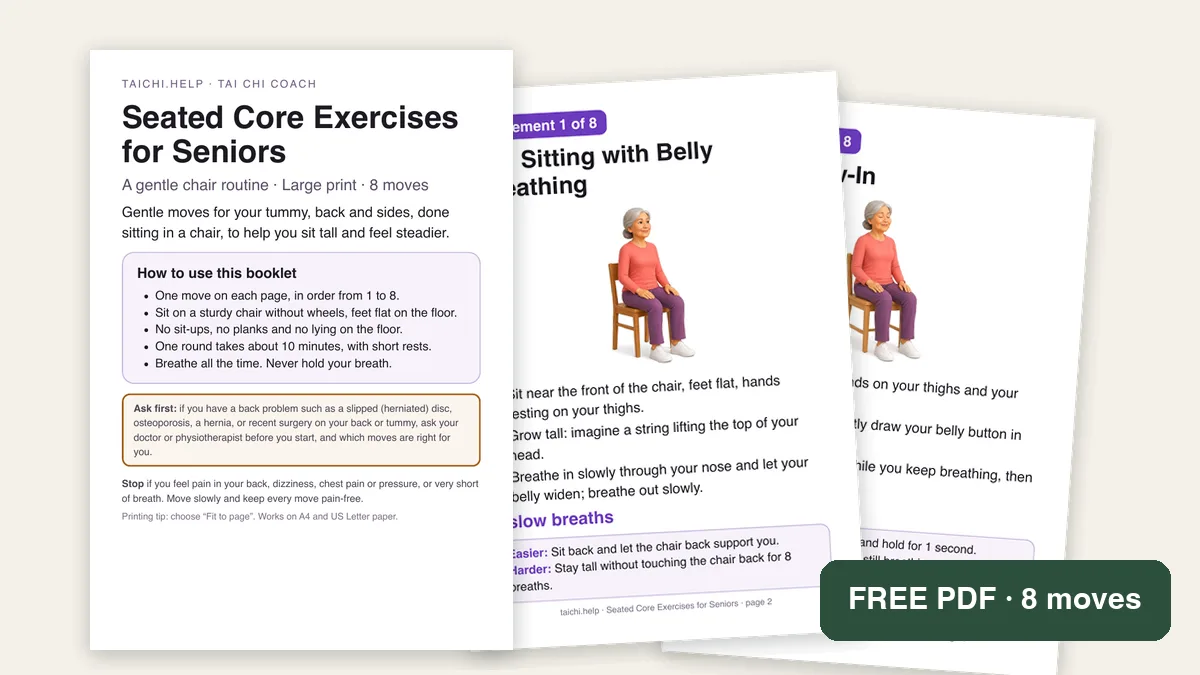
Reviewed by Tai Chi Coach Editorial Team
Reviewed for source accuracy, safety framing, and scope clarity on 2026-11-25. This is educational wellness content, not diagnosis or treatment advice. See our Editorial Policy.
Core exercises for seniors can be done sitting in a sturdy chair: no sit-ups, no planks and no getting down on the floor.
The routine below has 8 gentle seated moves for your tummy, back and sides, about 10 minutes a round. They help you practise sitting tall and holding your body steady while your arms and legs move. The free printable PDF has a picture of each move, easier and harder versions, and a 28-day tracker.
- What it is: a free, large-print PDF with 8 seated core exercises, one move per page, each with a picture.
- Who it is for: older adults who want a stronger middle but can't or don't want to exercise on the floor, and caregivers or activity leaders who print routines for others.
- How long: about 10 minutes a round (about 5 minutes in week 1).
- Equipment: a sturdy chair without wheels. Nothing else.
- Not included: sit-ups, crunches, planks or lying down.
Before you start: ask first, and when to stop
Ask your doctor or physiotherapist first if you have a back problem such as a slipped (herniated) disc, osteoporosis, a hernia, or recent surgery on your back or tummy. Ask which of these moves are right for you.
Stop right away if you feel pain in your back, dizziness, chest pain or pressure, or very short of breath. Sit still and rest. If chest pain or sudden breathlessness does not pass, get medical help.
- Use a solid, stable chair without wheels, placed against a wall. The NHS also suggests a chair without arms for its sitting exercises.
- Sit near the front of the seat with both feet flat. If your feet don't reach, rest them on a firm book.
- Breathe all the time. Holding your breath while you tighten your tummy makes the move harder, not better.
- Keep every move small and pain-free. A twist or a lean only needs to go as far as is comfortable.
What's inside the free printable PDF
The PDF has 11 pages in large print. The first page explains how to use it and who should ask first. Each of the next 8 pages shows one move with a big drawing, three short steps, how many times to do it, and an easier and a harder version. Then comes a 28-day tracker with the 4-week plan, and a last page about our full printable programmes.
It prints on A4 or US Letter paper. Choose "Fit to page" in the print window.
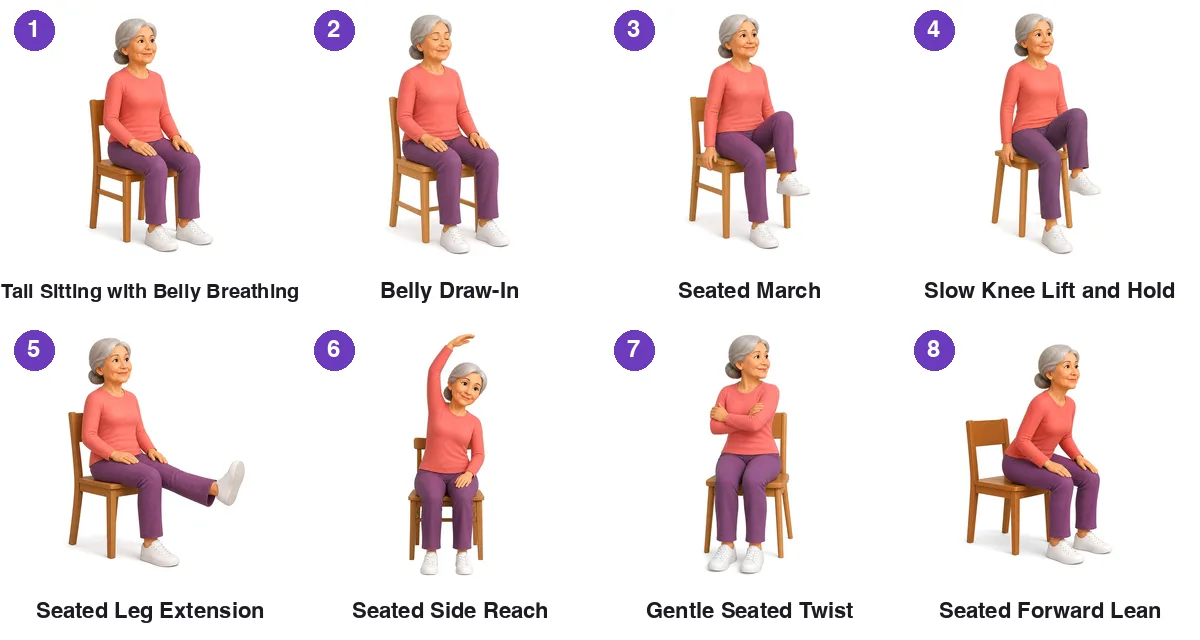
The 8 seated core exercises, step by step
Do the moves in order. Moves 1 and 2 teach you to sit tall and breathe while your tummy works; moves 3 to 5 keep you steady while your legs move; moves 6 to 8 work your sides and back. Rest for a few breaths between moves whenever you need to. The same steps are in the PDF, one move per page.
1. Tall Sitting with Belly Breathing
- Sit near the front of the chair, feet flat, hands resting on your thighs.
- Grow tall: imagine a string lifting the top of your head.
- Breathe in slowly through your nose and let your belly widen; breathe out slowly.
How many: 5 slow breaths.
- Easier: Sit back and let the chair back support you.
- Harder: Stay tall without touching the chair back for 8 breaths.
2. Belly Draw-In
- Sit tall with your hands on your thighs and your shoulders relaxed.
- Breathe out and gently draw your belly button in toward your spine.
- Hold for 3 seconds while you keep breathing, then relax.
How many: 8 times.
- Easier: Draw in only a little and hold for 1 second.
- Harder: Hold for 5 seconds, still breathing normally.
3. Seated March
- Sit tall near the front of the chair, hands on the seat edges.
- Lift one foot a little off the floor, then put it down.
- Lift the other foot. Keep your back tall; don't lean back.
How many: 30 seconds to 1 minute.
- Easier: Lift only your heels and keep your toes down.
- Harder: Cross your arms over your chest while you march.
4. Slow Knee Lift and Hold
- Sit tall and hold the sides of the seat.
- Draw your belly in, then slowly lift one knee a few inches.
- Hold for 3 seconds, lower it slowly, then switch legs.
How many: 5 times each leg.
- Easier: Lift the knee only an inch or two.
- Harder: Hold for 5 seconds with your hands resting on your thighs.
5. Seated Leg Extension
- Sit tall with both feet flat and your hands on the seat edges.
- Straighten one knee so the foot lifts, toes pointing up.
- Hold for 3 seconds, lower slowly, then switch legs.
How many: 5 times each leg.
- Easier: Straighten the knee only part of the way.
- Harder: Hold for 5 seconds without leaning back.
6. Seated Side Reach
- Sit tall with both feet flat and your sitting bones pressing down.
- Reach one arm up and lean gently to the other side.
- Come back to the middle, then reach with the other arm.
How many: 4 times each side.
- Easier: Slide one hand down the side of the chair instead of reaching up.
- Harder: Pause for one slow breath at each side.
7. Gentle Seated Twist
- Sit tall, feet flat, arms crossed loosely over your chest.
- Turn your upper body slowly to one side, only as far as is comfortable.
- Come back to the middle, then turn to the other side.
How many: 4 times each side.
- Easier: Keep your hands on your thighs and make the turn smaller.
- Harder: Hold each turn for one slow breath.
8. Seated Forward Lean
- Sit near the front of the chair with your hands on your knees.
- Keep your back straight and lean forward a little from your hips.
- Use your tummy and back muscles to sit tall again.
How many: 6 times.
- Easier: Make the lean very small.
- Harder: Cross your arms over your chest as you lean and come back.
How to progress over 4 weeks
Build up slowly. Move on to the next week only when the current one feels comfortable, and stay longer at a level if you need to.
- Week 1: Moves 1 to 4 only, a few times each · about 5 minutes.
- Week 2: All 8 moves, the easier versions where you need them.
- Week 3: All 8 moves at the number of times on each page · about 10 minutes.
- Week 4: Try the harder version of 2 or 3 moves, if they feel comfortable.
Tick a box on the 28-day tracker after each session. Short sessions on most days are easier to keep up than one long session a week.
Core, posture and balance: where to go next
A steady middle is what lets you sit tall and stay upright when you reach, turn or stand up. When this seated routine feels easy and you can stand safely next to a chair, try our free balance exercises for seniors PDF, which trains standing balance with a chair for support. If your back is the main worry, read tai chi for back pain first. For a calmer, flowing seated practice, see chair tai chi, our longer seated exercises for seniors programme, or the general chair exercises for seniors PDF.
Frequently Asked Questions
Can seniors strengthen their core sitting in a chair?
Yes, you can work the muscles around your middle without getting down on the floor. Sitting tall without leaning on the chair back, drawing your belly in while you breathe, lifting a knee or straightening a leg slowly, and gentle side reaches and twists all ask your tummy and back muscles to hold you steady. Start small and build up over a few weeks.
What are good core exercises for seniors?
Good choices are moves you can do safely and often. This routine uses 8 of them, all seated: tall sitting with belly breathing, the belly draw-in, the seated march, a slow knee lift and hold, the seated leg extension, a seated side reach, a gentle seated twist and a seated forward lean.
Are sit-ups and planks safe for seniors?
Many older adults can't easily get down to the floor and back up, so this routine leaves out sit-ups, crunches and planks altogether. If you want to add floor exercises, ask a physiotherapist to show you a version that suits your back and joints.
How often should seniors do core exercises?
Most days is a good aim for a short, gentle routine like this one. One round takes about 10 minutes. In week 1, do only moves 1 to 4, then add the rest as they feel comfortable.
Who should check with a doctor before doing core exercises?
Ask your doctor or physiotherapist first if you have a back problem such as a slipped (herniated) disc, osteoporosis, a hernia, or recent surgery on your back or tummy. Stop if you feel pain in your back, dizziness, chest pain or pressure, or very short of breath.
Is the core exercises for seniors PDF really free?
Yes. Enter your email in the box on this page and the 11-page PDF opens instantly. There is no payment, and you can unsubscribe from our emails anytime.
Want a full 28-day plan?
The free routine is a good start. For a day-by-day plan you do from a chair, start with the 28-Day Seated Exercises for Seniors programme ($4.90), or get the Seated Set: four illustrated 28-day programmes (seated exercises, chair tai chi, chair yoga and qigong) for $9.90 one-time. The Complete Library has all six programmes for $14.90.
See the Seated SetNext step
Take it further with the Tai Chi Coach app
Prefer to follow along with video? The Tai Chi Coach app has guided seated and standing routines for seniors and beginners. It is free to download; Day 1 is free and the full plan comes with Premium.