

Morning Stretches for Seniors: A Free Printable 10-Minute Routine
Free printable morning stretches
Get the 11-page large-print PDF: 8 stretches with pictures, easier and harder versions, and a 28-day tracker. Print it and keep it by your bed.
Want the full printable pack?
The Active Set: three illustrated 28-day programmes (standing tai chi, tai chi walking and qigong); $9.90 one-time.
Yes, show me the packYour PDF is opening in a new tab.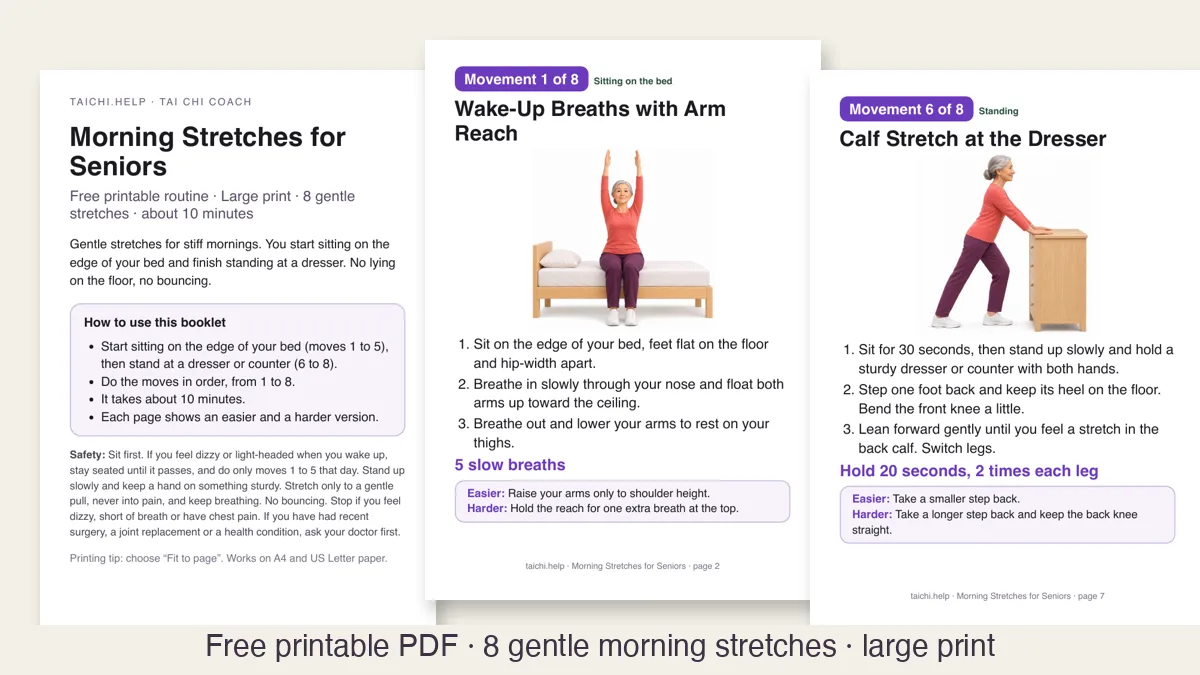
Reviewed by Tai Chi Coach Editorial Team
Reviewed for source accuracy, safety framing, and scope clarity on 2026-11-25. This is educational wellness content, not diagnosis or treatment advice. See our Editorial Policy.
Morning stretches for seniors work best when you start sitting on the edge of the bed and only stand once you feel steady.
This free printable routine has 8 gentle stretches and takes about 10 minutes: 5 on the edge of the bed, then 3 standing at a dresser or kitchen counter. There is no lying on the floor and no bouncing, and each move has an easier version for stiff days.
- What it is: a free, large-print PDF with 8 gentle morning stretches, one per page, each with a picture.
- Who it is for: adults over 60 who wake up stiff, and family members or carers who print routines for them.
- How long: about 10 minutes. The 5 seated stretches alone take about 5 minutes.
- What you need: your bed, and a sturdy dresser or counter for the standing moves. Flat, non-slip shoes or bare feet on a non-slip floor.
Before you start: sit first, and know when to stop
Sit first. Many people feel light-headed when they get up quickly. Sit on the edge of the bed with your feet on the floor before you start, and stand up slowly before move 6. The NHS advice for people who feel dizzy on standing is to move slowly from lying to sitting to standing. If you feel dizzy, stay seated and do only moves 1 to 5 that day.
Stop right away if you feel dizzy, short of breath, chest pain or pressure, or sharp pain anywhere. A stretch should feel like a gentle pull, never pain.
Ask your doctor first if you have had recent surgery or a joint replacement, have osteoporosis or a back problem, often feel dizzy or have fallen in the past year.
- Move slowly and keep breathing. Don't bounce into a stretch.
- Use a bed that doesn't slide, and keep the floor around it clear.
- For moves 6 to 8, hold a heavy dresser, a kitchen counter or a bed rail, not a chair with wheels or a light table.
What's inside the free printable PDF
The PDF has 11 pages in large print. The first page explains how to use it and how to stay safe. Each of the next 8 pages shows one stretch with a big drawing, three short steps, how much to do, and an easier and a harder version. Then comes a 28-day tracker, and a last page about our full printable programmes.
It prints on A4 or US Letter paper. Choose "Fit to page" in the print window.
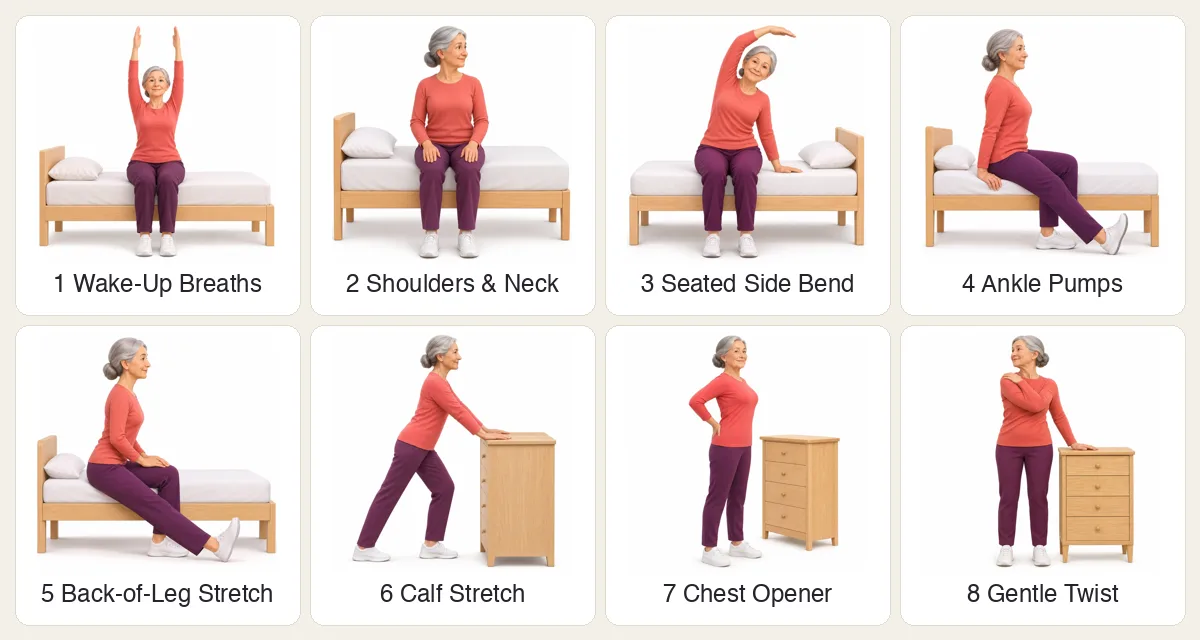
The 8 morning stretches, step by step
Do the stretches in order. Moves 1 to 5 are done sitting on the edge of your bed, moves 6 to 8 standing with a hand on something sturdy. The same steps are in the PDF, one stretch per page.
1. Wake-Up Breaths with Arm Reach
- Sit on the edge of your bed, feet flat on the floor and hip-width apart.
- Breathe in slowly through your nose and float both arms up toward the ceiling.
- Breathe out and lower your arms to rest on your thighs.
How much: 5 slow breaths (sitting on the bed, about 1 minute).
- Easier: Raise your arms only to shoulder height.
- Harder: Hold the reach for one extra breath at the top.
2. Shoulder Rolls and Neck Turns
- Lift your shoulders toward your ears, roll them back, then let them drop.
- Sit tall and turn your head slowly to look over your right shoulder.
- Come back to the middle, then turn to the left. Move only as far as feels easy.
How much: 5 rolls, then 3 turns each way (sitting on the bed, about 1 minute).
- Easier: Make the rolls smaller and turn your head only halfway.
- Harder: Pause for 2 slow breaths at the end of each turn.
3. Seated Side Bend
- Rest your left hand on the bed beside you.
- Reach your right arm up and over your head, and lean gently to the left.
- Breathe in the stretch for 2 breaths, come back up, then switch sides.
How much: 3 times each side (sitting on the bed, about 1 minute).
- Easier: Keep the reaching hand on your shoulder instead of overhead.
- Harder: Reach a little further and hold for 3 breaths.
4. Ankle Pumps and Circles
- Sit tall and slide one foot a little forward, heel on the floor.
- Point your toes away from you, then pull them back toward you.
- Then lift the foot slightly and draw slow circles with your ankle. Switch feet.
How much: 10 pumps and 5 circles each way, each foot (sitting on the bed, about 1 minute).
- Easier: Keep your heel on the floor the whole time.
- Harder: Hold each point and pull for 2 seconds.
5. Seated Back-of-Leg Stretch
- Sit near the edge of the bed. Straighten one leg forward, heel on the floor, toes up.
- Keep your back long and lean forward a little from your hips, hands on the bent knee.
- Hold while you breathe slowly. Feel a gentle pull behind the straight leg. Switch legs.
How much: Hold 20 seconds, 2 times each leg (sitting on the bed, about 1.5 minutes).
- Easier: Lean forward only a little, or bend the straight knee slightly.
- Harder: Hold for 30 seconds.
Before move 6: stay sitting for about 30 seconds, then stand up slowly and hold your dresser or counter. If you feel dizzy, sit back down and stop here for today.
6. Calf Stretch at the Dresser
- Sit for 30 seconds, then stand up slowly and hold a sturdy dresser or counter with both hands.
- Step one foot back and keep its heel on the floor. Bend the front knee a little.
- Lean forward gently until you feel a stretch in the back calf. Switch legs.
How much: Hold 20 seconds, 2 times each leg (standing, about 1.5 minutes).
- Easier: Take a smaller step back.
- Harder: Take a longer step back and keep the back knee straight.
7. Standing Chest Opener
- Stand tall next to the dresser, feet hip-width apart.
- Place both hands on your lower back, fingers pointing down.
- Breathe in and gently draw your elbows back to open your chest. Keep your chin level.
How much: 5 slow breaths, 2 times (standing, about 1 minute).
- Easier: Keep one hand on the dresser and open one side at a time.
- Harder: Clasp your hands behind your back and lift them a little.
8. Standing Gentle Twist
- Stand tall beside the dresser, left hand on it, right hand on your left shoulder.
- Keep your hips facing forward and turn your chest and head slowly to the right.
- Come back to the middle, then turn slowly to the left.
How much: 4 times each side (standing, about 1 minute).
- Easier: Turn only a little and keep both hands on the dresser.
- Harder: Cross your arms over your chest and pause for one breath at each side.
How to build the habit over 4 weeks
Go gently. The aim is a few easy minutes every morning, not a deeper stretch each day. Stay at a week for longer if you need to.
- Week 1: do moves 1 to 5 sitting on the bed every morning, and add moves 6 to 8 on days you feel steady, using the easier versions.
- Week 2: do all 8 moves as written, holding the dresser for every standing move.
- Week 3: breathe more slowly into each stretch, and try one harder version on a good day.
- Week 4: do the full routine most mornings and use the harder versions where they feel comfortable.
Tick a box on the 28-day tracker after each morning. The NHS flexibility exercises page gives the same advice: build up slowly and increase the repetitions gradually over time.
Where morning stretching fits in
Stretching is one part of staying active. For older adults, the CDC's activity guidelines recommend at least 150 minutes a week of moderate activity, muscle-strengthening activities on at least 2 days and activities that improve balance, and note that some physical activity is better than none. A morning stretch is a gentle way to start the day; add walking or other activity later in the day when you can.
If standing is hard for you, our free chair exercises for seniors PDF is done entirely in a chair, and seated tai chi is a calm seated practice. If you are steady on your feet and want to work on balance, try the free balance exercises for seniors PDF. For a slow flowing start to the day, see the beginner morning qigong routine.
Frequently Asked Questions
What are the best morning stretches for seniors?
Gentle stretches you can start sitting down: deep breaths with an arm reach, shoulder rolls and neck turns, a seated side bend, ankle pumps and a seated stretch for the back of the leg. Once you are steady on your feet, add a calf stretch, a chest opener and a gentle twist while holding a dresser or counter. That is the order used in the free PDF.
How long should seniors stretch in the morning?
This routine takes about 10 minutes. On a busy or stiff morning, the 5 seated stretches alone take about 5 minutes. A short routine you do most mornings is easier to keep up than a long one you skip.
Should I stretch before I get out of bed?
Sit up first, then stretch. Sit on the edge of the bed with your feet on the floor for a moment before you stand. The NHS advises people who feel dizzy when they get up to move slowly from lying to sitting to standing. That is why moves 1 to 5 are done sitting and the standing moves come last.
Is it better to stretch in the morning or at night?
Either is fine; what matters most is doing it regularly. Many people like a few minutes in the morning because that is when they feel stiffest, and it is easy to tie to getting out of bed. If you prefer the evening, the same stretches work then too.
Why do I feel so stiff in the morning?
After hours of lying still, muscles and joints often feel stiff until you start moving, and gentle movement usually helps. If your stiffness lasts a long time, comes with swelling, redness or new pain, or is getting worse, talk to your doctor rather than stretching through it.
Is the morning stretches PDF really free?
Yes. Enter your email in the box on this page and the 11-page PDF opens instantly. There is no payment, and you can unsubscribe from our emails anytime.
Want a full 28-day plan?
The free stretches are a good start to the day. For a day-by-day plan on your feet, start with the 28-Day Standing Tai Chi programme ($4.90), or get the Active Set: three illustrated 28-day programmes (standing tai chi, tai chi walking and qigong) for $9.90 one-time. The Complete Library has all six programmes for $14.90.
See the Active SetNext step
Take it further with the Tai Chi Coach app
Prefer to follow along with video? The Tai Chi Coach app has guided seated and standing routines for seniors and beginners. It is free to download; Day 1 is free and the full plan comes with Premium.