

Reviewed by Tai Chi Coach Editorial Team
Reviewed for source accuracy, safety framing, and scope clarity on 2026-10-13. This is educational wellness content, not diagnosis or treatment advice. See our Editorial Policy.
Lymphatic Tai Chi Walking: A Gentle 7-Minute Routine You Can Do at Home
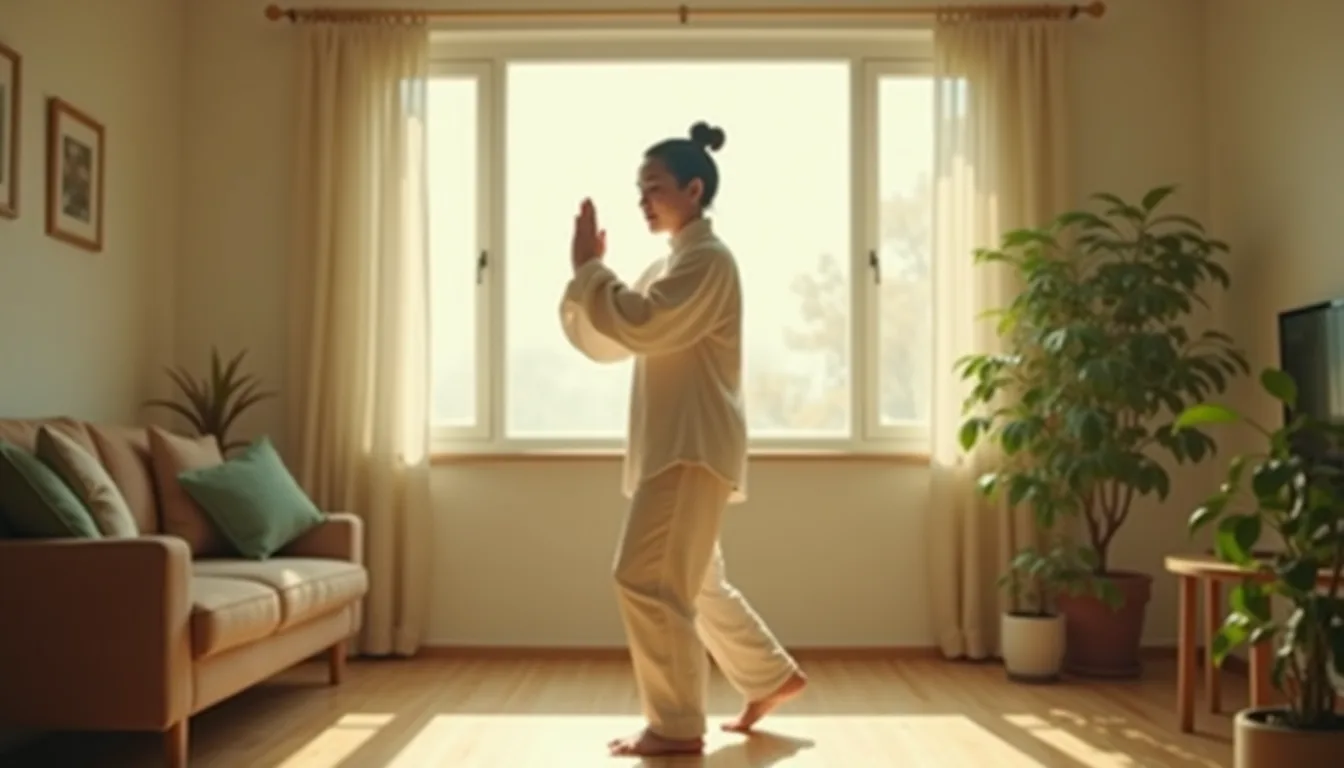
Watch: a 10-minute beginner session to follow along
A beginner-friendly session you can repeat daily at home.

Page guide
Looking for Tai Chi walking?
Use the main Tai Chi walking page for the guided 28-day path. Use the PDF page only if you want a printable sheet.
Lymphatic tai chi walking is slow, tai chi-style walking combined with deep belly breathing, calf work and easy arm movements. The idea behind it is simple: your lymphatic system has no pump of its own, so it relies on muscle movement and breathing to keep fluid flowing. This routine gives it both, gently, in about seven minutes.
Key takeaways
- It is not a separate tai chi style. It is ordinary tai chi walking, done with slower breathing and more calf and arm movement.
- Why it may help: lymph is moved along by muscle contractions, especially in the calves, and by the pressure changes of deep breathing. Slow walking provides both.
- What it won't do: "detox" you or drain your body in a way ordinary gentle movement does not. No study has tested this exact routine.
- Dose: about 7 minutes a day, ideally after long periods of sitting. A seated version is below.
- Check first if you have sudden swelling in one leg, diagnosed lymphedema, heart failure or kidney disease.
What is lymphatic tai chi walking?
The name is a newer one, spread mostly by short online videos. Strip away the label and you get three ingredients tai chi teachers have used for a long time: slow steps where the heel lands first and the weight shifts fully from one foot to the other; slow breathing from the belly, timed with the steps; and soft arm movements that rise and fall with the breath.
What makes the "lymphatic" version different from our standard tai chi walking routine is emphasis, not technique: longer exhales, deliberate heel raises to work the calves, and arm lifts that open the chest and armpits.
Why walking and breathing move lymph
Blood has the heart. Lymph, the clear fluid that collects in your tissues and returns to the bloodstream, has no central pump. It travels through vessels with one-way valves, and it is pushed along by a few things:
- Muscle squeeze. When the calf and thigh muscles contract, they press on nearby vessels and push fluid onward. That is why ankles tend to look puffy after a long flight or an afternoon of sitting, and feel lighter after a walk.
- Breathing. A deep breath changes the pressure inside the chest and belly, which helps draw fluid up through the large vessels in the trunk.
- Regular movement. Moving the joints and limbs through the day keeps tissues from staying still for hours at a time. The lymph vessels also contract slowly on their own, and activity supports that rhythm.
Slow tai chi walking happens to combine all three at an effort level almost anyone can manage. That is the honest case for it: not a special technique, but a very easy way to give your lymphatic system the movement it depends on every day.
The 7-minute lymphatic tai chi walking routine
You need a clear path of three or four metres (a hallway is perfect) and a chair or wall within reach. Wear flat shoes or go barefoot.
- Belly breathing (1 minute). Stand tall with your knees soft and one hand on your belly. Breathe in through the nose for about 4 counts so the belly rises, then breathe out for about 6 counts. Keep the exhale longer than the inhale.
- Heel raises at the chair (1 minute). Hold the back of the chair. Rise slowly onto the balls of your feet, pause, and lower slowly, 10 to 15 times. This is the "calf pump", the most important part for the legs.
- Tai chi steps forward (2 minutes). Step forward heel first while your weight stays on the back leg, then roll the front foot flat and shift your weight forward slowly. Take one step on the inhale and the next on the exhale. Turn slowly at the end of the hallway and walk back.
- Steps with arm lifts (1 minute). Keep walking the same way. As you breathe in, let both arms float up in front of you to shoulder height; as you breathe out, let them sink. Keep the shoulders relaxed.
- Side steps with cloud hands (1 minute). Step sideways, bring the feet together, and step again, four or five steps each way. Let the hands pass slowly in front of the chest and waist, one after the other, as if wiping a window.
- Closing (1 minute). Stand still. Do five slow shoulder rolls backwards, then three belly breaths, lowering the hands down the front of the body on each exhale.
| # | Step | Time | Focus |
|---|---|---|---|
| 1 | Belly breathing | 1 min | Long, slow exhales |
| 2 | Heel raises at the chair | 1 min | The calf pump: 10–15 slow raises |
| 3 | Tai chi steps forward | 2 min | Heel first, full weight shift, one step per breath |
| 4 | Steps with arm lifts | 1 min | Arms float up on the inhale, sink on the exhale |
| 5 | Side steps with cloud hands | 1 min | Hands pass slowly in front of the body |
| 6 | Closing | 1 min | Shoulder rolls and three belly breaths |
Total: about 7 minutes. If it feels easy after a week, repeat steps 3 to 5 for a 10 to 12 minute session.
How often, and when
Once a day is plenty; twice is fine. The most useful moments are after long periods of sitting (a flight, a car trip, an afternoon at a desk or in front of the TV) and in the evening if your ankles tend to feel puffy. Consistency matters more than length: seven minutes every day beats half an hour once a week.
Seated version (if standing is hard)
Everything except the walking itself can be done from a sturdy chair:
- Ankle pumps: point and flex both feet, 15 to 20 times.
- Seated marching: lift one knee, then the other, slowly, for one minute.
- Arm lifts with belly breathing: as in step 4, 8 to 10 times.
- Cloud hands from the chair: as in step 5, 10 slow passes.
For a full seated routine with more movements, see our tai chi chair workout for seniors.
What the evidence says, and what it doesn't
No study has tested "lymphatic tai chi walking" as a named routine, so be wary of any page that quotes results for it. What is reasonably well established:
- Muscle activity and breathing are among the main forces that move lymph, which is why movement is part of standard lymphedema care.
- Regular exercise that starts gently and builds up slowly is generally considered safe for people with lymphedema.
- Tai chi itself is well studied for balance and fall prevention in older adults. A few small studies have looked at tai chi or qigong for arm swelling after breast cancer treatment, with early and mixed results.
What is not supported: claims that this routine "detoxes" the body, flushes out toxins, causes quick weight loss, or replaces treatment such as compression garments or manual lymphatic drainage from a trained therapist.
Safety: who should check with a doctor first
- Sudden swelling, pain, warmth or redness in one leg or arm. This can be a blood clot or an infection. Get it checked the same day; don't try to walk it off.
- Diagnosed lymphedema. Keep wearing any compression you have been prescribed, start with a few minutes, and ask your lymphedema therapist how to fit this into your plan.
- Heart failure, kidney or liver disease. Swelling in these conditions has a different cause; follow your doctor's guidance on activity.
- Balance problems or recent surgery. Use the seated version, or walk next to a wall or kitchen counter.
Stop if anything hurts or you feel dizzy. Gentle means gentle.
Get the routine on paper
The free tai chi walking PDF has the walking steps with pictures and a 7-day tracker, so you can print it and keep it by the hallway. If you would rather be guided day by day, the 28-day tai chi walking program builds the habit one short session at a time.
Frequently asked questions
What is lymphatic tai chi walking?
It is slow, tai chi-style walking (heel first, a full weight shift from one foot to the other) combined with long belly breaths, heel raises and gentle arm lifts. It is not a separate tai chi style; the "lymphatic" part refers to using muscle movement and breathing, which are what move lymph fluid around the body.
Does tai chi walking help lymphatic drainage?
Muscle movement and deep breathing do help lymph flow, and slow tai chi walking provides both at a very gentle effort level. There is no evidence that it works better than other gentle movement, and it is not a substitute for lymphedema treatment.
How long should I do lymphatic tai chi walking?
About 7 minutes a day is a good start. You can build up to 10 to 15 minutes, or do two short sessions a day, especially after long periods of sitting.
Is lymphatic tai chi walking good for seniors?
For most older adults it is one of the gentlest options: slow, low-impact, and done next to a chair or wall for support. If balance is a concern, use the seated version.
Can I do lymphatic tai chi walking if I have lymphedema?
Many people with lymphedema can, but start with a few minutes, keep wearing any compression you have been prescribed, and check with your lymphedema therapist first.
Is it the same as lymphatic drainage massage?
No. Manual lymphatic drainage is a hands-on technique done by a trained therapist. Lymphatic tai chi walking is a movement routine you do yourself; it can sit alongside therapy but does not replace it.
Is there a free printable version?
Yes. The free tai chi walking PDF has the walking steps with pictures and a 7-day tracker, and it opens without a sign-up.
Free printable routine
Get the 7-day Tai Chi walking routine as a PDF. Print it, put it on the fridge, start today.
🎁 Bonus: a printable 28-day tracking calendar
We can email it to you too — tick off each day and enjoy one gentle reminder a week.
No thanksWant the full printable pack?
28 illustrated movements + 28 full-page cards + 6 planners; $9.90 one-time.
Yes, show me the packYour PDF is opening in a new tab.Next step
Make it a daily 7-minute habit
The routine helps when you do it every day. Download our free Tai Chi app for iPhone and follow short, guided sessions at home: gentle, low-impact and no equipment, so the habit sticks.