

Reviewed by Tai Chi Coach Editorial Team
Reviewed for source accuracy, safety framing, and scope clarity on 2026-08-10. This is educational wellness content, not diagnosis or treatment advice. See our Editorial Policy.
Tai Chi Walking PDF: The Free Printable Routine
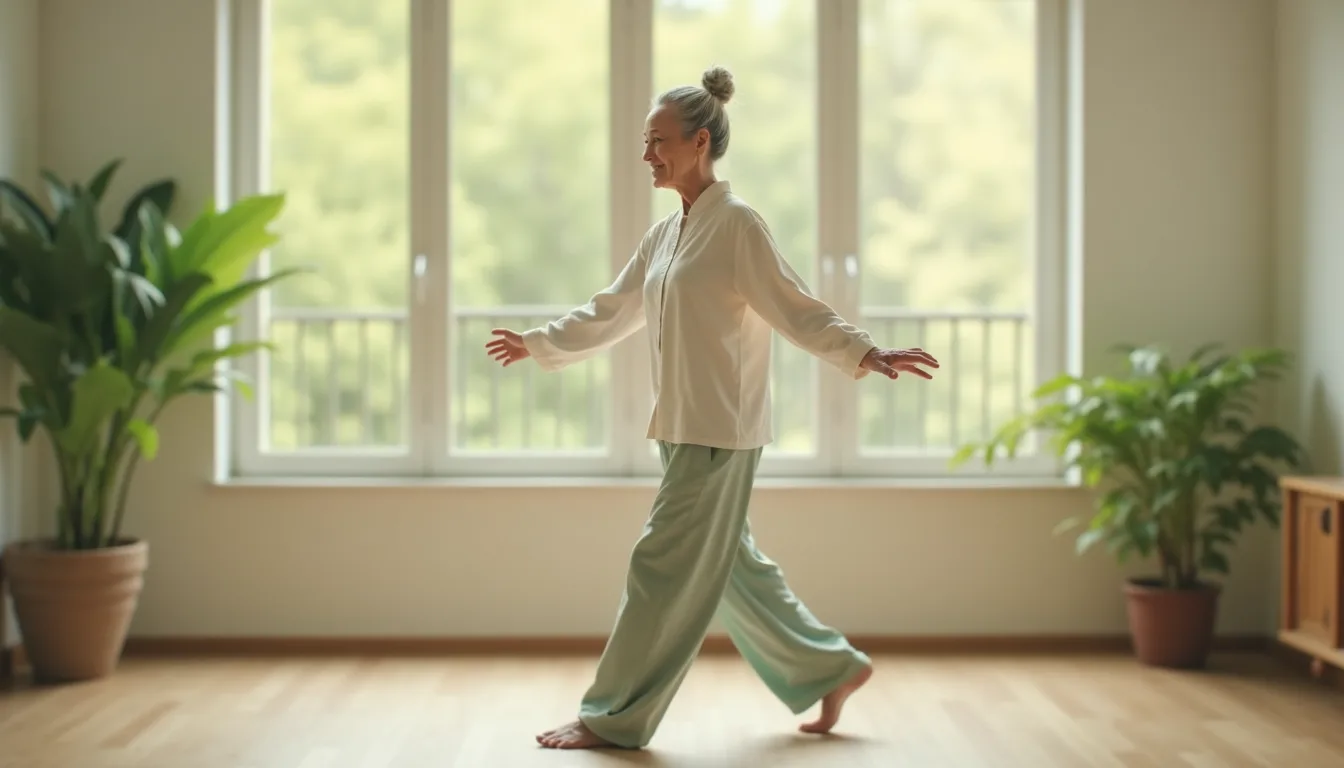
Watch: 10-Minute Tai Chi for Weight Loss & Balance
A beginner-friendly session you can repeat daily at home.

Page guide
Want the guided 28-day version?
This free PDF gives you the routine on one page. If you'd rather have each day planned for you — illustrated cards, gradual progression, and a printable calendar — the 28-day walking program builds on this same routine.
If you are looking for a free printable Tai Chi Walking PDF, it is right below: a roughly ten-minute routine condensed onto a single page, downloadable instantly, with no sign-up and no email address. Tai Chi Walking is a slow, low-impact way to move indoors — soft steps in place or across the room, matched to your breath and to easy circling arms. According to the NCCIH, regular Tai Chi practice may support balance, mobility, and stress management.
Download the free printable PDF
Free printable walking routine (PDF)
Get the 7-day Tai Chi walking routine as a PDF. Print it, put it on the fridge, start today.
Want the full printable walking program?
28 illustrated movements + 28 full-page cards + 6 planners; $4.90 one-time.
Yes, show me the programYour PDF is opening in a new tab.Key takeaways
- The PDF is completely free: no sign-up, no email, no hidden cost. Download it and print it as many times as you like.
- The routine takes about 10 minutes and fits on one page, sized for the fridge door or the table beside your chair.
- You only need two or three metres of clear floor and a chair or wall for support. No equipment at all.
- Tai Chi Walking is joint-friendly: no jumping, no jerking, and no impact through the knees.
- Consistency beats duration — ten minutes on most days does more than one long session a week.
What's inside the free PDF
The file is built for printing: large type, readable in black and white, everything on a single side. Inside you'll find:
- The full step sequence, from warm-up to close, in the right order.
- A short cue for each stage plus the suggested time in minutes.
- The breathing and posture pointers — the two details that genuinely change the quality of the practice.
- A 5-minute short version for busy days.
- A small tick-box calendar and the safety notes in summary form.
The Tai Chi Walking routine in 6 steps
Move slowly and without stopping and starting, as if you were walking through water. Don't chase a perfect posture: stay within a range that feels comfortable, and pause whenever you want to.
- Rooting (1 minute). Stand tall, feet hip-width apart, knees soft, shoulders released. Breathe slowly down into the lower belly and feel your weight spread across the whole sole of each foot.
- Weight shifting (2 minutes). Without moving your feet, shift your weight slowly onto the right leg, then the left. The torso stays upright and the movement comes from the hip. This is the move the whole walk is built on.
- The Tai Chi step (3 minutes). Settle all your weight onto one leg, place the other heel in front of you with no weight on it, then roll the weight gradually from heel to toes. Alternate sides. If space is tight, step in place at the same tempo.
- Adding the arms (2 minutes). Layer a soft arm movement over the steps: one hand rises in front of the chest while the other sinks towards the hip, as in "cloud hands". Keep the shoulders low.
- Stepping backwards (1 minute). Optional, and only with support within reach. Take a half-step back, placing the ball of the foot first and the heel second. Go very slowly — it's excellent balance training.
- Closing (1 minute). Come to a stop, rest both palms on your lower belly and take five slow breaths. Notice how your legs feel now compared with when you started.
All six steps are summarised in the PDF, with the timings printed alongside:
Safety notes
- Keep support within reach. A sturdy chair, the kitchen counter, or a wall — especially in the first few weeks and for anyone over 70.
- Clear floor, flat shoes. Move slippery rugs and cables out of the way. Bare feet or flat shoes are best; loose slippers are not.
- No pain. A mild working sensation in the legs is fine; sharp pain is not. If it appears, shorten the step or stop.
- Don't hold your breath. If you notice you are, slow down further — the walk follows the breath, not the other way round.
- If you feel dizzy, sit down. Only continue once you feel steady again.
- Check with your doctor if you have heart conditions, significant osteoporosis, frequent dizziness, recent surgery, or a history of falls.
Common beginner mistakes
- Stepping too far. Long steps force you to fall into the next foot. Halve your step length and the control comes back immediately.
- Locking the knees. Straight legs cannot absorb a weight shift. Keep a soft bend throughout.
- Looking at your feet. This pulls your head down and shifts your balance forward. Pick a point at eye level and keep it.
- Holding the breath during the harder parts. If you notice you have stopped breathing, the movement is too fast or too big.
- Practising on carpet in thick socks. You lose the floor feedback you are trying to build, and add slip risk at the same time.
Tai Chi walking for seniors (with chair support)
Many people search for a tai chi walking for beginners step by step pdf because they want a routine that will not overwhelm stiff joints or shaky balance — and Tai Chi Walking is genuinely one of the gentler ways to move. If standing through the full ten minutes feels like too much some days, keep a sturdy chair or the kitchen counter within arm's reach for the whole session, not just the backward step. You can also do the weight-shifting and arm movements while seated, letting your feet "walk" in place against the floor instead of travelling across the room — the breathing and posture cues in the PDF apply exactly the same way. Older adults with recent falls, joint replacements, or unsteady balance often start seated for the first week or two, then move to standing once the steps feel automatic. There is no rush: the routine works at either pace, and keeping a chair nearby is a sign of good judgment, not a lesser workout.
Tai Chi walking for weight loss: what to realistically expect
Tai Chi Walking shows up constantly in searches for weight loss, and it's worth being honest about what a gentle, ten-minute routine can realistically do. On its own, it burns a modest number of calories — it's closer to a slow walk than a cardio workout — so it's unlikely to be the main driver of fat loss by itself. What it does well is build the habit of moving daily, and according to the NCCIH, regular Tai Chi practice may support balance and mobility, which in turn makes it easier to stay active in other ways throughout the day. Many people find that once stiffness and balance worries ease, they naturally walk further, stand more, and move more overall — and that broader activity is what tends to affect weight over time. If weight loss is your main goal, treat this routine as the on-ramp: pair the ten minutes with regular walks outdoors, a sensible diet, and gradually longer sessions, rather than expecting the routine alone to do the work.
What people mean by "lymphatic" Tai Chi walking
A growing number of searches ask about "lymphatic" Tai Chi walking, usually referring to the idea that gentle, rhythmic movement can help the lymphatic system — the network that drains fluid and waste from tissue — move more effectively, since unlike blood it has no central pump and relies partly on muscle contraction and movement to circulate. It's an appealing idea, and there's nothing risky about the movement itself: the slow steps, ankle and calf engagement, and easy arm circles in this routine are exactly the kind of low-impact activity that keeps muscles working gently throughout a session. What we won't do is claim that Tai Chi Walking has been shown to specifically "detox" the body or clear the lymphatic system in a way ordinary movement does not — that specific claim goes beyond what the current evidence supports. What is better supported is more modest: gentle movement in general, including walking, supports circulation and can leave joints and muscles feeling less stiff. If lymphatic health is a specific concern, it's worth raising with a doctor or physiotherapist rather than relying on any single routine.
If you want a version built around this idea, with longer exhales, heel raises and a seated option, see our 7-minute lymphatic tai chi walking routine.
From the free routine to 28 days
If ten minutes a day already feels manageable, the natural next question is what to do with day two, day ten, or day twenty-eight. The tick-box tracker in the free PDF, and the free 28-day calendar we can email you, give you a simple way to track consistency: mark each day you practise, and let the streak itself become the motivation, rather than chasing a harder routine before you're ready. For the first week, the goal is simply completing the six-step routine at an easy pace most days. From roughly day eight, once the steps feel familiar, you can extend the walking or weight-shifting phases by a minute or two, or add the optional backward step. By day twenty-eight most people find the sequence runs almost automatically, and many choose to extend it rather than stop. If you'd like every day mapped out for you in advance — with progression built in instead of figured out on your own — that's exactly what the paid 28-day program below adds on top of this same free routine.
Want the full 28-day program?
The free PDF gives you the routine. If you'd rather have each day decided for you — with gradual progression, variations, and a calendar to follow — our main Tai Chi Walking guide brings together the 28-day path and the printable pack.
28-day Tai Chi Walking program: short sessions that grow with you, illustrated printable cards, and a planner to keep the rhythm going. One-time payment, no subscription.
See the 28-day programPrefer to practise seated?
If standing for long is tiring, or your balance isn't reliable yet, that's no obstacle: almost every principle of Tai Chi Walking transfers to a chair, with the feet "walking" in place and the arms following the breath.
Seated Tai Chi: a complete chair routine with its own printable PDF — ideal for limited mobility or after a long recovery.
Go to Seated Tai ChiTurning the PDF into a habit
The sheet on the fridge is a good start, but regularity is what makes the difference. Attach the routine to a moment that already exists in your day — after the morning coffee, before the evening news — and tick off each day on the PDF's calendar. After two or three weeks the steps run almost by themselves and you'll reach for the support far less often.
To go deeper, does Tai Chi Walking actually work? summarises what the research supports, while Tai Chi indoor walking covers room setup and posture in a small flat. If weight is part of your goal, read Tai Chi Walking for weight loss; and there's a dedicated version for older adults: free Tai Chi Walking for seniors.
Frequently asked questions
Is the Tai Chi Walking PDF really free?
Yes, entirely. You click the button, the file opens or saves, and you can print it as often as you like. We don't ask for a sign-up, an email address, or payment details.
How much space do I need for Tai Chi Walking?
Two or three clear metres are enough, and even less if you step in place. Many people practise in a hallway or between the sofa and the window — the routine in the PDF is designed for small spaces.
How long should I practise each day?
The full routine takes about ten minutes, and the PDF also includes a five-minute short version. Four or five sessions a week is a good starting rhythm: consistency matters more than length.
Is Tai Chi Walking suitable for seniors?
It's one of the gentlest forms of movement there is: slow, with no jumping and no joint impact. Anyone with shaky balance should practise near a chair or wall, and people with medical conditions or recent falls should check with a doctor or physiotherapist first.
Can I do Tai Chi Walking sitting down?
Yes. The arm movements and breath coordination work identically in a chair, with the feet keeping the rhythm in place. There's a complete seated routine at taichi.help/seated-tai-chi/.
Do I need a video, or is the PDF enough?
The PDF stands on its own and many people use nothing else. If you'd rather see a movement before trying it, the free Tai Chi Coach app shows each step as a guided video.
Can I do Tai Chi walking for seniors from a chair?
Yes. Every step in the routine — the weight shift, the arm circles, even the Tai Chi step itself — works while seated, with your feet walking in place. Keep the chair sturdy and stay near a wall or counter if you decide to try the standing version afterward.
Is Tai Chi walking safe for beginners with balance problems?
It's one of the safer options because there's no jumping and no fast direction changes, but anyone with a history of falls, dizziness, or a recent injury should keep support within reach and check with a doctor or physiotherapist before starting.
Does Tai Chi walking actually help you lose weight?
It can support weight loss indirectly — by building strength, balance, and a daily movement habit — but ten minutes of gentle walking burns a modest number of calories on its own. Most people see the best results when they pair it with regular walking or other activity.
How many calories does a Tai Chi walking session burn?
It's roughly comparable to a slow walk in terms of calories burned, which is modest next to vigorous cardio. The bigger benefit is consistency: a daily habit you'll actually keep adds up more, over weeks, than one hard session you skip most days.
What is "lymphatic" Tai Chi walking?
It's not a distinct style — it refers to the idea that gentle, rhythmic movement like Tai Chi Walking may support lymphatic circulation, since the lymphatic system relies on muscle movement rather than a central pump. The routine on this page is the same one; the "lymphatic" framing is about why gentle movement in general may help.
Does Tai Chi walking really stimulate lymphatic drainage?
There isn't strong evidence that Tai Chi specifically outperforms other gentle movement for lymphatic drainage. What's better supported is that movement in general — including slow walking — supports circulation. Treat any specific "detox" claim with caution, and speak with a doctor about lymphatic concerns.
Is there a free 28-day Tai Chi walking plan?
The free PDF gives you this routine with a 7-day tick-box tracker, and we can email you a free printable 28-day calendar so you can keep the streak going, gradually extending the walking and weight-shifting phases as it becomes familiar. For a plan with each day mapped out in advance, see the paid 28-day program on this page.
Where can I find free Tai Chi walking videos to follow?
The video embedded on this page is a free ten-minute session you can follow along with, and the free Tai Chi Coach app includes guided video for each step of the routine if you'd like more visual guidance.
Next step
Printed the PDF? Practise along with video
The sheet tells you what to do; the video shows you how. Download the free Tai Chi Coach app for iPhone and follow Tai Chi Walking step by step in short 10-minute sessions, standing or seated, entirely at your own pace.